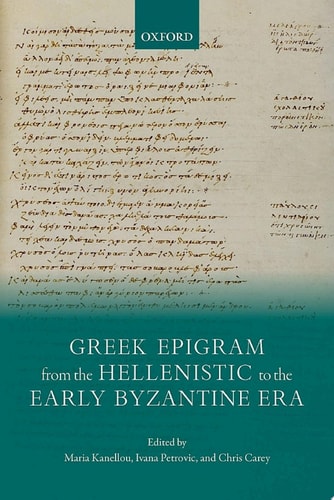
Greek Epigram from the Hellenistic to the Early Byzantine Era
0
0
As an Amazon Associate and affiliate partner, Menrva Books earns from qualifying purchases. Learn more
Author Description
Greek epigram is a remarkable poetic form. The briefest of all ancient Greek genres, it is also the most resilient: for almost a thousand years it attracted some of the finest Greek poetic talents as well as exerting a profound influence on Latin literature, and it continues to inspire and influence modern translations and imitations. After a long period of neglect, research on epigram has surged during recent decades, and this volume draws on the fruits of that renewed scholarly engagement. It is concerned not with the work of individual authors or anthologies, but with the complexities of epigram as a genre, and provides a selection of in-depth treatments of key aspects of Greek literary epigram of the Hellenistic, Roman, and early Byzantine periods. Individual chapters offer insights into a variety of topics, from the dynamic interactions between poets and their predecessors and contemporaries, and the relationship between epigram and its sociopolitical, cultural, and literary background from the third century BCE up until the sixth century CE, to its interaction with its origins, inscribed epigram more generally, other literary genres, the visual arts, and Latin poetry, as well as the process of editing and compilation that generated the collections that survived into the modern world. Through the medium of individual studies the volume as a whole seeks to offer a sense of this vibrant and dynamic poetic form and its world, which will be of value to scholars and students of Greek epigram and classical literature more broadly.
Menrva's Summary
THE THESIS
This volume investigates the evolution, structural complexity, and cultural significance of the Greek epigram as a distinct literary genre spanning from the Hellenistic period through the early Byzantine era. The editors, Chris Carey, Ivana Petrovic, and Maria Kanellou, curate a collection of scholarly essays that examine the genre's resilience and its interactions with broader sociopolitical and artistic contexts. By moving beyond individual author studies, the contributors provide a framework for understanding how epigrammatic poetry functioned as a dynamic, evolving medium over nearly a millennium.
THE SCOPE MAP
What You Will Find
- Analysis of the interaction between epigram and contemporary literary genres
- Examination of the relationship between poetic texts and the visual arts
- Discussion of the editorial processes involved in compiling ancient anthologies
- Studies on the influence of Greek epigram on Latin literature
Scope Limits
- Does not focus on the biography or complete works of individual poets
- Excludes analysis of epigrammatic development beyond the sixth century CE
THE AUTHORITY PERSPECTIVE
Experts identify this volume as a significant contribution to the recent surge in scholarly interest regarding the formal and cultural mechanics of ancient epigram. Readers frequently note the academic density of the prose, which serves as a specialized resource for students and researchers of classical literature.
Page Count:
459
Publication Date:
2019-01-01
Publisher:
OUP Oxford
ISBN-10:
0192573799
ISBN-13:
9780192573797
Poetry
Criticism history
English
English & College Success
Ancient History
Literary Criticism
Epigrams