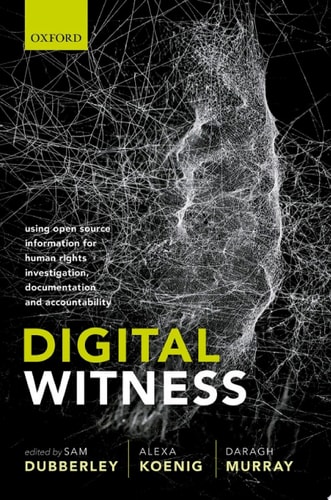
Digital Witness: Using Open Source Information for Human Rights Investigation, Documentation, and Accountability
0
0
As an Amazon Associate and affiliate partner, Menrva Books earns from qualifying purchases. Learn more
Author Description
From videos of rights violations, to satellite images of environmental degradation, to eyewitness accounts disseminated on social media, human rights practitioners have access to more data today than ever before. To say that mobile technologies, social media, and increased connectivity are having a significant impact on human rights practice would be an understatement. Modern technology - and the enhanced access it provides to information about abuse - has the potential to revolutionise human rights reporting and documentation, as well as the pursuit of legal accountability. However, these new methods for information gathering and dissemination have also created significant challenges for investigators and researchers. For example, videos and photographs depicting alleged human rights violations or war crimes are often captured on the mobile phones of victims or political sympathisers. The capture and dissemination of content often happens haphazardly, and for a variety of motivations, including raising awareness of the plight of those who have been most affected, or for advocacy purposes with the goal of mobilising international public opinion. For this content to be of use to investigators it must be discovered, verified, and authenticated. Discovery, verification, and authentication have, therefore, become critical skills for human rights organisations and human rights lawyers. This book is the first to cover the history, ethics, methods, and best-practice associated with open source research. It is intended to equip the next generation of lawyers, journalists, sociologists, data scientists, other human rights activists, and researchers with the cutting-edge skills needed to work in an increasingly digitized, and information-saturated environment.
Menrva's Summary
THE THESIS
This book investigates how open source information can be systematically utilized to document human rights violations and secure legal accountability in an era of digital saturation. The authors, Alexa Koenig, Daragh Murray, and Sam Dubberley, draw upon their extensive expertise in law and human rights advocacy to provide a comprehensive framework for navigating the complexities of digital evidence. They argue that while mobile technology and social media provide unprecedented access to information, the utility of this data depends entirely on rigorous discovery, verification, and authentication protocols.
THE SCOPE MAP
What You Will Find
- Historical context of open source research in human rights advocacy
- Methodologies for discovering and verifying user-generated content
- Ethical considerations regarding the handling of sensitive digital evidence
- Best practices for preparing digital data for legal proceedings
Scope Limits
- The text does not provide a technical manual for specific software coding or advanced cybersecurity penetration testing
- It does not cover the internal policy-making processes of specific social media platforms
THE AUTHORITY PERSPECTIVE
Experts and practitioners identify this work as a foundational text for those entering the field of digital human rights investigation. Readers frequently note the clarity with which the authors bridge the gap between technical data collection and the stringent requirements of international law.
Page Count:
380
Publication Date:
2019-01-01
Publisher:
OUP Oxford
ISBN-10:
019257308X
ISBN-13:
9780192573087
Law
Open Source
Professional Career & Trade
Human rights
Technology
Journalism
Community Tags
Similar Books