Hegel's Antiquity
0
0
As an Amazon Associate and affiliate partner, Menrva Books earns from qualifying purchases. Learn more
Author Description
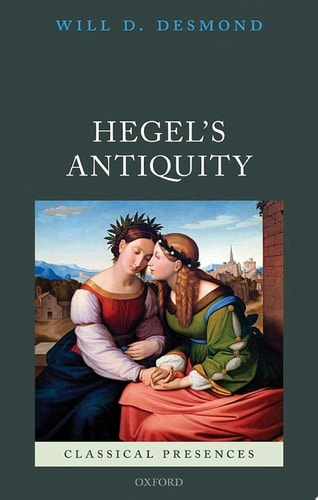
Hegel's Antiquity aims to summarize, contextualize, and criticize Hegel's understanding and treatment of major aspects of the classical world, approaching each of the major areas of his historical thinking in turn: politics, art, religion, philosophy, and history itself. The discussion excerpts relevant details from a range of Hegel's works, with an eye both to the ancient sources with which he worked, and the contemporary theories (German aesthetic theory, Romanticism, Kantianism, idealism (including Hegel's own), and emerging historicism) which coloured his readings. What emerges is that Hegel's interest in both Greek and Roman antiquity was profound and is essential for his philosophy, arguably providing the most important components of his vision of world-history: Hegel is generally understood as a thinker of modernity (in various senses), but his modernity can only be understood in essential relation to its predecessors and 'others', notably the Greek world and Roman world whose essential 'spirit' he assimilates to his own notion of Geist.
Menrva's Summary
THE THESIS
This work investigates the extent to which G.W.F. Hegel’s interpretation of classical antiquity serves as a foundational pillar for his broader philosophical system and his vision of world history. Will D. Desmond examines how Hegel’s engagement with Greek and Roman sources informs his concept of Geist, arguing that Hegel’s modernity is inextricably linked to his assimilation of ancient thought. The text synthesizes Hegel's diverse writings to demonstrate that his historical thinking is not merely a byproduct of his era, but a deliberate construction built upon his reading of the classical world.
THE SCOPE MAP
What You Will Find
- Analysis of Hegel’s treatment of politics, art, religion, philosophy, and history.
- Examination of the influence of German Aesthetic theory, Romanticism, and Kantianism on Hegel’s methodology.
- Comparative study of Hegel’s primary sources versus his interpretive conclusions.
Scope Limits
- The text focuses primarily on Hegel’s specific interpretation of antiquity rather than providing a comprehensive biography of the philosopher.
- It does not attempt to provide a general history of the ancient world independent of Hegel’s specific philosophical lens.
THE AUTHORITY PERSPECTIVE
Scholars recognize this text as a specialized contribution to the study of German Idealism and its classical roots. Readers frequently note the academic density of the prose, which is intended for those already familiar with Hegelian terminology and the broader context of 19th-century philosophy.
Page Count:
480
Publication Date:
2020-01-01
Publisher:
Oxford University Press
ISBN-10:
0192575732
ISBN-13:
9780192575739
Philosophy
History
Aesthetics
Political Theory