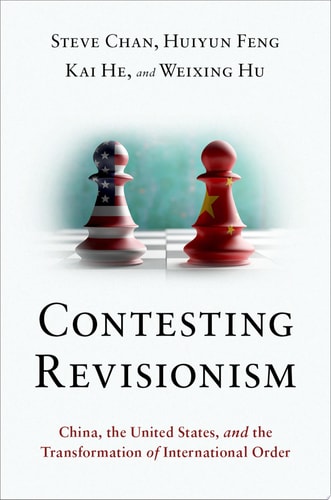
Contesting Revisionism: China, the United States, and the Transformation of International Order
0
0
As an Amazon Associate and affiliate partner, Menrva Books earns from qualifying purchases. Learn more
Author Description
How can we know a country, such as the United States or China, is revisionist, that is, whether it intends to upset the international order?What motivates states to act the way they do? Contesting Revisionism focuses on a particular kind of motivation inclining a state to challenge the existing norms, rules, and institutions of international order: revisionism. The authors offer a critique of the existing discourse on revisionism and investigate the origin and evolution of the foreign policy orientations of revisionist states in the past. Furthermore, they introduce an ensemble of indicators to discern and compare the extent of revisionist tendencies on the part of contemporary China and the United States. Questioning the facile assumption that past episodes will repeat in the future, they argue that "hard" revisionism relying on war and conquest is less viable and likely in today's world. Instead, "soft" revisionism seeking to promote institutional change is more relevant and likely. Focusing on contemporary Sino-American relations, they conclude that much of the current discourse based on power transition theory is problematic. A dominant power is not inevitably committed to the defense of international order, nor does a rising power always have a revisionist agenda to challenge this order. The transformation of international order does not necessarily require a power transition between China and the US., nor does a possible power transition necessarily augur war. After developing the concept of revisionism both theoretically and empirically, they conclude with a series of policy recommendations for enhancing international stability and diminishing tension in Sino-American relations.
Menrva's Summary
THE THESIS
This book investigates the criteria used to identify revisionist states and questions whether the rise of China necessarily threatens the existing international order led by the United States. The authors, a team of scholars specializing in international relations, challenge the prevailing power transition theory by critiquing how revisionism is defined and measured in contemporary discourse. They argue that the historical model of 'hard' revisionism—characterized by war and territorial conquest—is increasingly obsolete, proposing instead that 'soft' revisionism focused on institutional reform is the more likely path for modern powers. By synthesizing historical analysis with new empirical indicators, the text provides a framework for understanding state motivations beyond the binary of status quo versus revisionist.
THE SCOPE MAP
What You Will Find
- A critical evaluation of power transition theory and its application to modern Sino-American relations.
- A conceptual framework distinguishing between 'hard' revisionism and 'soft' revisionism.
- An ensemble of empirical indicators designed to measure and compare revisionist tendencies in state behavior.
- Policy recommendations aimed at mitigating geopolitical tensions and enhancing global stability.
THE AUTHORITY PERSPECTIVE
Experts in the field of international relations recognize this work as a significant contribution to the debate on great power competition. Scholars frequently note the analytical rigor with which the authors dismantle simplistic assumptions regarding the inevitability of conflict between rising and dominant powers.
Page Count:
232
Publication Date:
2021-01-01
Publisher:
Oxford University Press
ISBN-10:
0197580327
ISBN-13:
9780197580325
History
Foreign Policy
Comparative Politics
Geopolitics
International relations
Community Tags
Similar Books