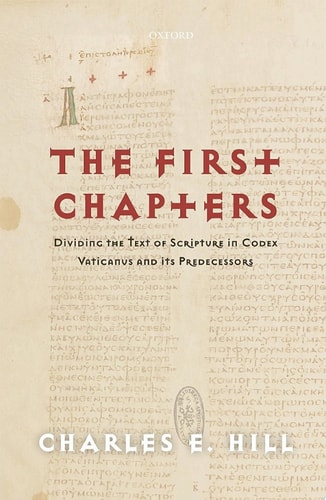
The First Chapters: Dividing the Text of Scripture in Codex Vaticanus and Its Predecessors
0
0
As an Amazon Associate and affiliate partner, Menrva Books earns from qualifying purchases. Learn more
Author Description
The First Chapters uncovers the origins of the first paragraph or chapter divisions in copies of the Christian Scriptures. Its focal point is the magnificent, fourth-century Codex Vaticanus (Vat.gr. 1209; B 03), perhaps the single most significant ancient manuscript of the Bible, and the oldest material witness to what may be the earliest set of numbered chapter divisions of the Bible. The First Chapters tells the history of textual division, starting from when copies of Greek literary works used virtually no spaces, marks, or other graphic techniques to assist the reader. It explores the origins of other numbering systems, like the better-known Eusebian Canons, but its theme is the first set of numbered chapters in Codex Vaticanus, what nineteenth-century textual critic Samuel P. Tregelles labelled the Capitulatio Vaticana. It demonstrates that these numbers were not, as most have claimed, late additions to the codex but belonged integrally to its original production. The First Chapters then breaks new ground by showing that the Capitulatio Vaticana has real precursors in some much earlier manuscripts. It thus casts light on a long, continuous tradition of scribally-placed, visual guides to the reading and interpreting of Scriptural books. Finally, The First Chapters exposes abundant new evidence that this early system for marking the sense-divisions of Scripture has played a much greater role in the history of exegesis than has previously been imaginable.
Menrva's Summary
THE THESIS
This work investigates the origins and historical significance of the earliest numbered chapter divisions found within the fourth-century Codex Vaticanus. Charles E. Hill, a scholar of early Christian history and textual criticism, utilizes a rigorous analysis of ancient manuscript evidence to challenge the prevailing consensus regarding the Capitulatio Vaticana. By examining the physical production of early biblical codices, Hill argues that these numbering systems were integral to the original manuscripts rather than later additions, thereby establishing a continuous tradition of scribal guidance in early biblical interpretation.
THE SCOPE MAP
What You Will Find
- Detailed analysis of the Capitulatio Vaticana within Codex Vaticanus (Vat.gr. 1209).
- Comparative study of early Greek literary formatting and biblical manuscript traditions.
- Examination of the Eusebian Canons and other historical numbering systems.
- Evidence regarding the influence of early sense-divisions on the history of exegesis.
Scope Limits
- The study focuses primarily on the Greek manuscript tradition and does not provide an exhaustive survey of later medieval or post-Reformation chapter divisions.
- The analysis is limited to the technical and historical aspects of textual division rather than theological commentary on the content of the scriptures themselves.
THE AUTHORITY PERSPECTIVE
Scholars in the field of textual criticism recognize this work as a significant contribution to the understanding of ancient manuscript production and the history of biblical formatting. Readers frequently note the technical density of the prose, which requires a foundational knowledge of paleography and early Christian history to fully appreciate the author's arguments.
Page Count:
506
Publication Date:
2022-01-01
Publisher:
OUP Oxford
ISBN-10:
0192573020
ISBN-13:
9780192573025
Religion
Paleography
Bible
Christianity - History
Community Tags
Similar Books