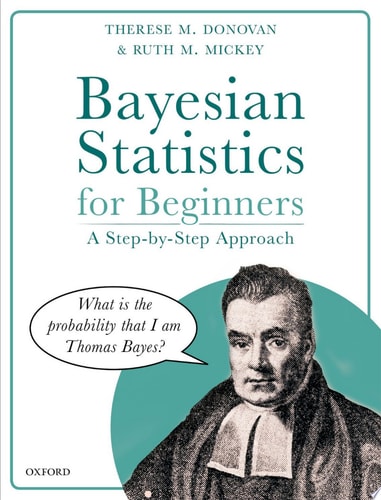
Bayesian Statistics for Beginners: A Step-by-Step Approach
0
0
As an Amazon Associate and affiliate partner, Menrva Books earns from qualifying purchases. Learn more
Author Description
Bayesian statistics is currently undergoing something of a renaissance. At its heart is a method of statistical inference in which Bayes' theorem is used to update the probability for a hypothesis as more evidence or information becomes available. It is an approach that is ideally suited to making initial assessments based on incomplete or imperfect information; as that information is gathered and disseminated, the Bayesian approach corrects or replaces the assumptions and alters its decision-making accordingly to generate a new set of probabilities. As new data/evidence becomes available the probability for a particular hypothesis can therefore be steadily refined and revised. It is very well-suited to the scientific method in general and is widely used across the social, biological, medical, and physical sciences. Key to this book's novel and informal perspective is its unique pedagogy, a question and answer approach that utilizes accessible language, humor, plentiful illustrations, and frequent reference to on-line resources. Bayesian Statistics for Beginners is an introductory textbook suitable for senior undergraduate and graduate students, professional researchers, and practitioners seeking to improve their understanding of the Bayesian statistical techniques they routinely use for data analysis in the life and medical sciences, psychology, public health, business, and other fields.
Menrva's Summary
THE THESIS
This book investigates the fundamental question of how researchers can apply Bayesian inference to update hypotheses as new data becomes available. Authors Ruth M. Mickey and Therese M. Donovan, both experienced academics, present a pedagogical framework designed to demystify complex statistical concepts. By utilizing a question-and-answer format, the text bridges the gap between theoretical probability and practical application in scientific research. The authors emphasize the iterative nature of Bayesian analysis, demonstrating how initial assumptions are refined through the systematic integration of new evidence.
THE SCOPE MAP
What You Will Find
- An introduction to Bayes' theorem and its application in statistical inference
- A question-and-answer pedagogical structure designed for clarity
- Integration of online resources and visual illustrations to support learning
- Applications across social, biological, medical, and physical sciences
Scope Limits
- Advanced mathematical proofs or high-level theoretical derivations
- Comprehensive coverage of non-Bayesian frequentist statistical methods
THE AUTHORITY PERSPECTIVE
Experts and educators frequently highlight this text as a highly accessible entry point for students and practitioners who find traditional statistical literature overly dense. The informal tone and practical focus make it a favored resource for those needing to implement Bayesian techniques in applied research settings.
Page Count:
432
Publication Date:
2019-01-01
Publisher:
OUP Oxford
ISBN-10:
0192578251
ISBN-13:
9780192578259
Mathematics
textbook
Probability
Academic
Data Science
Decision Theory
Statistics
Mathematics Statistics
Community Tags
Similar Books