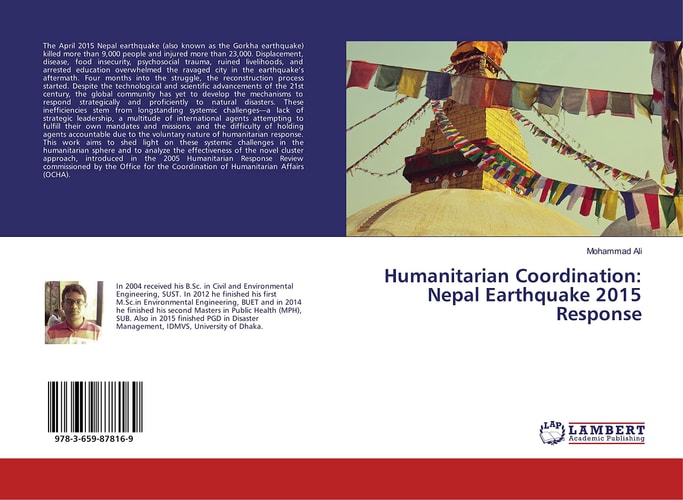
Humanitarian Coordination: Nepal Earthquake 2015 Response
0
0
As an Amazon Associate and affiliate partner, Menrva Books earns from qualifying purchases. Learn more
Author Description
The April 2015 Nepal earthquake (also known as the Gorkha earthquake) killed more than 9,000 people and injured more than 23,000. Displacement, disease, food insecurity, psychosocial trauma, ruined livelihoods, and arrested education overwhelmed the ravaged city in the earthquake’s aftermath. Four months into the struggle, the reconstruction process started. Despite the technological and scientific advancements of the 21st century, the global community has yet to develop the mechanisms to respond strategically and proficiently to natural disasters. These inefficiencies stem from longstanding systemic challenges—a lack of strategic leadership, a multitude of international agents attempting to fulfill their own mandates and missions, and the difficulty of holding agents accountable due to the voluntary nature of humanitarian response. This work aims to shed light on these systemic challenges in the humanitarian sphere and to analyze the effectiveness of the novel cluster approach, introduced in the 2005 Humanitarian Response Review commissioned by the Office for the Coordination of Humanitarian Affairs (OCHA).
Menrva's Summary
THE THESIS
This work investigates the systemic challenges and effectiveness of humanitarian coordination in the aftermath of the 2015 Nepal earthquake. The April 2015 earthquake devastated Nepal, causing immense loss of life and widespread destruction, leading to displacement, disease, and food insecurity. Four months later, reconstruction efforts began, highlighting persistent global inefficiencies in disaster response, including a lack of strategic leadership, fragmented efforts by international agents, and accountability issues. This book analyzes the novel cluster approach introduced in 2005 by OCHA to address these systemic challenges in humanitarian spheres.
THE SCOPE MAP
- Analysis of the humanitarian coordination landscape following the 2015 Nepal earthquake.
- Examination of systemic challenges in international disaster response, such as leadership deficits and agent fragmentation.
- Evaluation of the effectiveness of the cluster approach as introduced by OCHA in 2005.
- Case study of a major natural disaster and its complex aftermath.
- Discussion on accountability mechanisms within voluntary humanitarian response.
THE AUTHORITY PERSPECTIVE
The book offers a critical examination of humanitarian coordination, focusing on the complexities and inefficiencies that arose during the 2015 Nepal earthquake response. It highlights the persistent challenges in global disaster management, including issues of leadership, coordination among numerous international agents, and accountability. The analysis centers on the effectiveness of the cluster approach, a framework designed to improve strategic and proficient responses to natural disasters. The work aims to shed light on these systemic issues within the humanitarian sphere.
Page Count:
68
Publication Date:
2016-09-05
Publisher:
LAP LAMBERT Academic Publishing
ISBN-10:
3659878162
ISBN-13:
9783659878169
Politics
History
Non-Fiction
Case Study
Community Tags
Similar Books