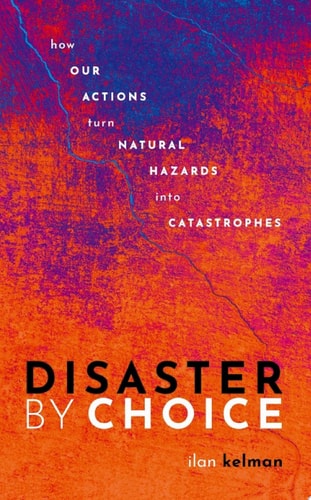
Disaster by Choice: How Our Actions Turn Natural Hazards into Catastrophes
0
0
As an Amazon Associate and affiliate partner, Menrva Books earns from qualifying purchases. Learn more
Author Description
An earthquake shatters Haiti and a hurricane slices through Texas. We hear that nature runs rampant, seeking to destroy us through these 'natural disasters'. Science recounts a different story, however: disasters are not the consequence of natural causes; they are the consequence of human choices and decisions. We put ourselves in harm's way; we fail to take measures which we know would prevent disasters, no matter what the environment does. This can be both hard to accept, and hard to unravel. A complex of factors shape disasters. They arise from the political processes dictating where and what we build, and from social circumstances which create and perpetuate poverty and discrimination. They develop from the social preference to blame nature for the damage wrought, when in fact events such as earthquakes and storms are entirely commonplace environmental processes. We feel the need to fight natural forces, to reclaim what we assume is ours, and to protect ourselves from what we perceive to be wrath from outside our communities. This attitude distracts us from the real causes of disasters: humanity's decisions, as societies and as individuals. It stops us accepting the real solutions to disasters: making better decisions. This book explores stories of some of our worst disasters to show how we can and should act to stop people dying when nature unleashes its energies. The disaster is not the tornado, the volcanic eruption, or climate change, but the deaths and injuries, the loss of irreplaceable property, and the lack and even denial of support to affected people, so that a short-term interruption becomes a long-term recovery nightmare. But we can combat this, as Kelman shows, describing inspiring examples of effective human action that limits damage, such as managing flooding in Toronto and villages in Bangladesh, or wildfires in Colorado. Throughout, his message is clear: there is no such thing as a natural disaster. The disaster lies in our inability to deal wit
Menrva's Summary
THE THESIS
The core question investigated is why human societies consistently misattribute the cause of catastrophes to natural phenomena rather than acknowledging the role of human decision-making. Ilan Kelman, a professor of disasters and health, utilizes his extensive academic background to argue that disasters are social constructs rather than inevitable environmental outcomes. By analyzing the intersection of political processes, poverty, and urban planning, he demonstrates that the failure to mitigate risk is a deliberate or negligent human choice. The text posits that by shifting focus from blaming nature to improving societal infrastructure and equity, humanity can effectively prevent the loss of life and property.
THE SCOPE MAP
What You Will Find
- Analysis of historical disaster events including earthquakes, hurricanes, and wildfires
- A framework for understanding the political and social drivers of vulnerability
- Case studies of successful disaster mitigation strategies in diverse regions like Toronto and Bangladesh
- Examination of the psychological tendency to externalize blame for environmental hazards
Scope Limits
- The text does not provide a technical manual for structural engineering or specific architectural design codes
- It does not focus on the geophysical mechanics of natural hazards themselves, but rather on the human response to them
THE AUTHORITY PERSPECTIVE
Experts in disaster risk reduction and environmental sociology frequently cite this work as a foundational text for understanding the social dimensions of vulnerability. Readers often note that the prose is accessible to a general audience while maintaining the academic rigor expected of a scholarly analysis.
Page Count:
179
Publication Date:
2020-01-01
Publisher:
OUP Oxford
ISBN-10:
0192578294
ISBN-13:
9780192578297
Non-Fiction
Earth Science
Earth Sciences
Geography
Sociology
Public Policy
Community Tags
Similar Books