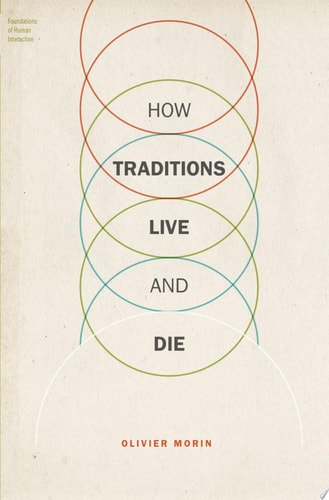
How Traditions Live and Die: Foundations of Human Interaction
0
0
As an Amazon Associate and affiliate partner, Menrva Books earns from qualifying purchases. Learn more
Author Description
Of all the things we do and say, most will never be repeated or reproduced. Once in a while, however, an idea or a practice generates a chain of transmission that covers more distance through space and time than any individual person ever could. What makes such transmission chains possible? For two centuries, the dominant view (from psychology to anthropology) was that humans owe their cultural prosperity to their powers of imitation. In this view, modern cultures exist because the people who carry them are gifted at remembering, storing and reproducing information. How Traditions Live and Die proposes an alternative to this standard view. What makes traditions live is not a general-purpose imitation capacity. Cultural transmission is partial, selective, often unfaithful. Some traditions live on in spite of this, because they tap into widespread and basic cognitive preferences. These attractive traditions spread, not by being better retained or more accurately transferred, but because they are transmitted over and over. This theory is used to shed light on various puzzles of cultural change (from the distribution of bird songs to the staying power of children's rhymes) and to explain the special relation that links the human species to its cultures. Morin combines recent work in cognitive anthropology with new advances in quantitative cultural history, to map and predict the diffusion of traditions. This book is both an introduction and an accessible alternative to contemporary theories of cultural evolution.
Menrva's Summary
THE THESIS
This book investigates the mechanisms that allow cultural traditions to persist and spread across time and space, challenging the traditional view that human imitation is the primary driver of cultural transmission.
Author Olivier Morin, a researcher in cognitive anthropology, argues that cultural survival is not dependent on high-fidelity imitation or perfect memory. Instead, he posits that traditions endure because they align with fundamental human cognitive preferences, making them inherently attractive and prone to repeated transmission despite the imperfect nature of human communication. By synthesizing cognitive anthropology with quantitative cultural history, Morin provides a framework for understanding why certain ideas and practices flourish while others vanish.
THE SCOPE MAP
What You Will Find
- A theoretical framework for cultural evolution based on cognitive preferences rather than imitation.
- Quantitative analysis of cultural diffusion patterns.
- Case studies ranging from avian vocalizations to the persistence of children's rhymes.
Scope Limits
- The text does not provide an exhaustive history of every human tradition.
- It does not focus on the neurological mechanics of memory storage in the brain.
THE AUTHORITY PERSPECTIVE
Experts in the field of cultural evolution recognize this work as a significant contribution to the debate regarding how traditions are maintained. Readers frequently note that the prose is accessible to those outside of academia while maintaining a rigorous analytical standard.
Page Count:
322
Publication Date:
2015-01-01
Publisher:
Oxford University Press
ISBN-10:
0190493313
ISBN-13:
9780190493318
Non-Fiction
Communications
English & College Success
Social change
Anthropology
English
Customs & Traditions
Introduction to Human Communication
Sociology
Linguistics
Socialization
Community Tags
Similar Books