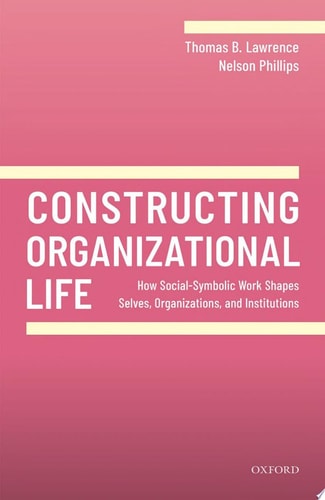
Constructing Organizational Life
0
0
As an Amazon Associate and affiliate partner, Menrva Books earns from qualifying purchases. Learn more
Author Description
Across The Social Sciences, Scholars Are Increasingly Showing How People 'work' To Construct Organizational Life, Including The Rules And Routines That Shape And Enable Organizational Activity, The Identities Of People Who Occupy Organizations, And The Societal Norms And Assumptions That Provide The Context For Organizational Action. The Idea Of Work Emphasizes The Ways In Which People And Groups Engage In Purposeful, Reflexive Efforts Rooted In An Awareness Of Organizational Life As Constructed In Human Interaction And Changeable Through Human Effort. Studies Of These Efforts Have Identified New Forms Of Work Including Emotion Work, Identity Work, Boundary Work, Strategy Work, Institutional Work, And A Host Of Others. Missing In These Conversations, However, Is A Recognition That These Forms Of Work Are All Part Of A Broader Phenomenon Driven By Historical Shifts That Began With Modernity And Dramatically Accelerated Through The Twentieth Century. This Book Introduces The Social-symbolic Work Perspective, Which Addresses This Broader Phenomenon. The Social-symbolic Work Perspective Integrates Diverse Streams Of Research To Examine How People Purposefully And Reflexively Work To Construct Organizational Life, Including The Identities, Technologies, Boundaries, And Strategies That Constitute Their Organizations. In This Book, The Authors Define Social-symbolic Work And Introduce Three Forms - Self Work, Organization Work, And Institutional Work. Social-symbolic Work Highlights People's Efforts To Construct The Social World, And Focuses Attention On The Motivations, Practices, Resources, And Effects Of Those Efforts. This Book Explores Eight Distinct Streams Of Social-symbolic Work Research, Drawing On A Broad Range Of Examples From The Worlds Of Business, Politics, Sports, Social Movements, And Many Others. It Provides Researchers, Students, And Practitioners With An Integrative Theoretical Framework Useful In Understanding Social-symbolic Work, A Survey Of The Main
Menrva's Summary
THE THESIS
How do individuals and groups purposefully construct the social and symbolic realities that define organizational life? Authors Nelson Phillips and Thomas B. Lawrence draw upon their extensive backgrounds in management and organizational studies to propose the 'social-symbolic work' perspective. This framework integrates disparate research streams to explain how human agency, reflexivity, and interaction shape the rules, identities, and institutional norms that constitute modern organizations.
THE SCOPE MAP
What You Will Find
- A comprehensive definition of social-symbolic work and its three primary forms: self work, organization work, and institutional work.
- An analysis of eight distinct research streams within the field.
- Case studies spanning business, politics, sports, and social movements.
Scope Limits
- The text focuses primarily on the theoretical integration of existing research rather than providing a practical 'how-to' manual for organizational management.
- It does not cover the psychological origins of individual motivation in isolation from social interaction.
THE AUTHORITY PERSPECTIVE
Scholars and students of organizational theory view this work as a significant effort to synthesize fragmented research into a cohesive analytical framework. Readers frequently note the academic density of the prose, which serves as a foundational text for those studying the social construction of institutions.
Page Count:
320
Publication Date:
2019-01-01
Publisher:
Oxford University Press
ISBN-10:
0192576305
ISBN-13:
9780192576309
Business
Management
Social Science
Organizational Theory
Sociology
Community Tags
Similar Books