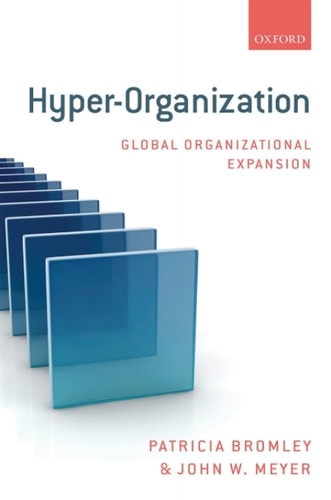
Hyper-Organization: Global Organizational Expansion
0
0
As an Amazon Associate and affiliate partner, Menrva Books earns from qualifying purchases. Learn more
Author Description
Hyper-Organization offers an institutional explanation for the expansion of formal organization in the contemporary era-in numbers, internal complexity, social domains, and national contexts. Much expansion is hard to justify in terms of technical production or political power, it lies in areas such as protecting the environment, promoting marginalized groups, or behaving with transparency. The authors argue that expansion is supported by widespread cultural rationalization characterized by scientism, rights and empowerment discourses, and an explosion of education. These cultural changes are transmitted through legal, accounting, and professionalization principles, driving the creation of new organizations and the elaboration of existing ones. The resulting organizations are constructed to be proper social actors, as much as functionally effective entities. They are painted as autonomous and integrated but depend heavily on external definitions to sustain this depiction. So expansion creates organizations that are, whatever their actual effectiveness, structurally arational. This book advances theories of social organization in three main ways. First, by giving an account of the expansive rise of 'organization' rooted in rapid worldwide cultural rationalization. Second, explaining the construction of contemporary organizations as purposive actors, rather than passive bureaucracies or loose associations. Third, showing how the expanded actorhood of the contemporary organization, and the associated interpenetration with the environment, dialectically generate structures far removed from instrumental rationality.
Menrva's Summary
THE THESIS
This book investigates the institutional drivers behind the rapid, global expansion of formal organizations in contemporary society. The authors, John W. Meyer and Patricia Bromley, utilize institutional theory to argue that organizational growth is less a product of technical efficiency and more a result of widespread cultural rationalization. They posit that modern organizations are constructed as purposive social actors, shaped by global discourses on rights, transparency, and scientism rather than purely functional requirements.
THE SCOPE MAP
What You Will Find
- Analysis of the global proliferation of formal organizations across diverse social domains.
- Theoretical framework explaining the shift from traditional bureaucracy to the modern 'purposive actor' model.
- Examination of how legal, accounting, and professional standards transmit cultural rationalization.
Scope Limits
- The text does not provide a manual for operational management or internal business efficiency.
- It does not focus on the success or failure of specific corporate entities in competitive markets.
THE AUTHORITY PERSPECTIVE
Scholars in the field of organizational sociology recognize this work as a significant contribution to the neo-institutionalist tradition. Readers frequently note the high level of academic density and the abstract nature of the theoretical arguments presented.
Page Count:
232
Publication Date:
2015-01-01
Publisher:
OUP Oxford
ISBN-10:
0191004146
ISBN-13:
9780191004148
Organizational Theory
Institutional Theory
Management
Social Science
Organization Development
Sociology
Community Tags
Similar Books