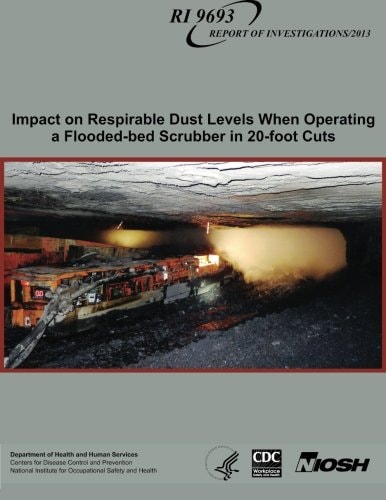
Impact on Respirable Dust Levels When Operating a Flooded-Bed Scrubber in 20-Foot Cuts
0
0
As an Amazon Associate and affiliate partner, Menrva Books earns from qualifying purchases. Learn more
Author Description
Underground coal mining companies that operate continuous miner sections often apply to the Mine Safety and Health Administration (MSHA) for approval to take extended cuts to depths of up to 40 ft as a means of improving productivity. Historically, MSHA has granted approval of this practice if the mine has successfully demonstrated the ability to control the roof, methane, and respirable dust while extracting these extended cuts. A key component for controlling dust generated by continuous miners in 40-ft cuts has been the utilization of flooded-bed scrubbers. These fan-powered scrubbers pull dust-laden air from the mining face and remove respirable dust particles by passing the collected air through a wetted filter panel. The filtered air is then discharged back into the mine atmosphere. To effectively use scrubbers in faces that employ exhaust ventilation, the return ventilation curtain or tubing should be located out by the scrubber discharge on the continuous miner, which results in a setback distance from the face of approximately 40 ft. Over the last several years, MSHA has emphasized that mines demonstrate effective dust control before granting approvals for taking extended cuts with extended curtain setbacks. Each mine operator must successfully demonstrate control of workers' dust exposures in standard 20-ft cuts before MSHA considers approving extended cuts. The goal of the research conducted by the National Institute for Occupational Safety and Health (NIOSH) was to compare dust levels generated in 20-ft cuts when using traditional exhaust face ventilation without a scrubber to dust levels in 20-ft cuts when using extended curtain setbacks with a scrubber operating. Dust surveys were completed at three mines, with area and personal sampling conducted to quantify respirable dust concentrations on a cut-by-cut basis. Dust sampling results did not show a statistically significant difference in respirable dust concentrations between these two test conditions
Menrva's Summary
THE THESIS
This research investigates the effectiveness of flooded-bed scrubbers in controlling respirable dust levels during underground coal mining operations. The study compares dust concentrations in 20-ft cuts using traditional exhaust face ventilation versus extended curtain setbacks with a scrubber. Researchers aimed to determine if scrubbers, when used with extended setbacks, could maintain comparable dust control to standard methods. The findings are crucial for mine operators seeking approval for extended cut operations, which improve productivity but require stringent dust control.
THE SCOPE MAP
- Comparison of respirable dust levels in 20-ft cuts under two ventilation scenarios: traditional exhaust face ventilation without a scrubber, and extended curtain setbacks with a scrubber.
- Data collected from dust surveys conducted at three underground coal mines.
- Use of both area and personal sampling to quantify respirable dust concentrations on a cut-by-cut basis.
- Analysis of the statistical significance of differences in respirable dust concentrations between the tested conditions.
- Insights into the operational parameters and ventilation strategies relevant to continuous miner sections.
THE AUTHORITY PERSPECTIVE
This technical report details a specific research study conducted by NIOSH to assess dust control methods in coal mining. The findings suggest that the use of flooded-bed scrubbers with extended curtain setbacks in 20-ft cuts did not yield a statistically significant difference in respirable dust concentrations compared to traditional exhaust face ventilation without a scrubber. This indicates that while scrubbers are a key component for dust control in longer cuts, their effectiveness in shorter, standard cuts under the tested conditions requires careful consideration for mine safety protocols.
Page Count:
68
Publication Date:
2014-02-21
Publisher:
CreateSpace Independent Publishing Platform
ISBN-10:
1496027493
ISBN-13:
9781496027498
Science & Technology
Non-Fiction
Occupational safety
Mining
Engineering
Community Tags
Similar Books









Reader Comments
Share Your Thoughts
No comments yet. Be the first to share your thoughts!