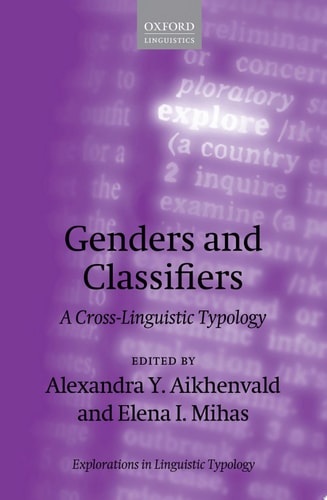
Genders and Classifiers: A Cross-Linguistic Typology
0
0
As an Amazon Associate and affiliate partner, Menrva Books earns from qualifying purchases. Learn more
Author Description
This volume offers a comprehensive account of the typology of noun classification across the world's languages. Every language has some means of categorizing objects into humans, or animates, or by their shape, form, size, and function. The most widespread are linguistic genders - grammatical classes of nouns based on core semantic properties such as sex (female and male), animacy, humanness, and also shape and size. Classifiers of several types also serve to categorize entities. Numeral classifiers occur with number words, possessive classifiers appear in the expressions of possession, and verbal classifiers are used on a verb, categorizing its argument. These varied sorts of genders and classifiers can also occur together. This volume elaborates on the expression, usage, history, and meanings of noun categorization devices, exploring their various facets across the languages of South America and Asia, which are known for the diversity of their noun categorization. The volume begins with a typological introduction that outlines the types of noun categorization devices and their expression, scope, functions, and development, as well as sociocultural aspects of their use. The following nine chapters provide in-depth studies of genders and classifiers of different types in a range of South American and Asian languages and language families, including Arawak languages, Zamucoan, Hmong, and Japanese.
Menrva's Summary
THE THESIS
This volume investigates the cross-linguistic typology of noun classification systems, specifically examining how languages categorize entities based on semantic properties such as animacy, shape, and function. Alexandra Y. Aikhenvald and Elena I. Mihas, both established scholars in linguistic typology, synthesize data from diverse language families to provide a framework for understanding the development and usage of genders and classifiers. The authors argue that noun categorization is a fundamental feature of human language, manifesting through varied grammatical devices that reflect both cognitive structures and sociocultural contexts.
THE SCOPE MAP
What You Will Find
- A typological introduction defining noun categorization devices including genders, numeral classifiers, possessive classifiers, and verbal classifiers.
- In-depth case studies of South American and Asian language families, including Arawak, Zamucoan, Hmong, and Japanese.
- Analysis of the historical development and functional evolution of categorization systems.
Scope Limits
- The text does not provide an exhaustive survey of every language family globally, focusing instead on specific regions known for high diversity in noun categorization.
THE AUTHORITY PERSPECTIVE
Experts in the field of linguistics recognize this work as a significant contribution to the study of noun classification and grammatical typology. Readers frequently note the academic density of the prose, which is intended for researchers and advanced students of linguistics.
Page Count:
336
Publication Date:
2019-01-01
Publisher:
OUP Oxford
ISBN-10:
0192579266
ISBN-13:
9780192579263
English & College Success
Academic
English
Reference
Linguistics
Grammar
Community Tags
Similar Books