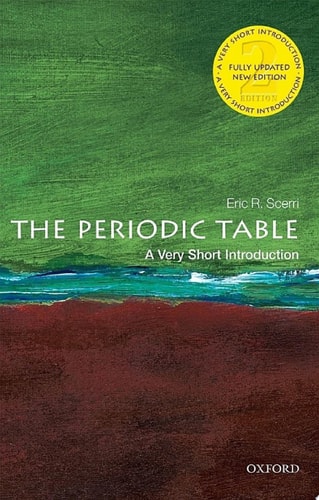
The Periodic Table: A Very Short Introduction
0
0
As an Amazon Associate and affiliate partner, Menrva Books earns from qualifying purchases. Learn more
Author Description
The periodic table of elements, first encountered by many of us at school, provides an arrangement of the chemical elements, ordered by their atomic number, electron configuration, and recurring chemical properties, and divided into periodic trends. In this Very Short Introduction Eric R. Scerri looks at the trends in properties of elements that led to the construction of the table, and shows how the deeper meaning of the table's structure gradually became apparent with the development of atomic theory and, in particular, quantum mechanics, which underlies the behaviour of all of the elements and their compounds. This new edition, publishing in the International Year of the Periodic Table, celebrates the completion of the seventh period of the table, with the ratification and naming of elements 113, 115, 117, and 118 as nihonium, moscovium, tennessine, and oganesson. Eric R. Scerri also incorporates new material on recent advances in our understanding of the origin of the elements, as well as developments concerning group three of the periodic table. ABOUT THE SERIES: The Very Short Introductions series from Oxford University Press contains hundreds of titles in almost every subject area. These pocket-sized books are the perfect way to get ahead in a new subject quickly. Our expert authors combine facts, analysis, perspective, new ideas, and enthusiasm to make interesting and challenging topics highly readable.
Menrva's Summary
THE THESIS
This book investigates the historical development and theoretical foundations of the periodic table of elements. Eric R. Scerri, a prominent philosopher and historian of chemistry, utilizes his expertise to explain how atomic theory and quantum mechanics provide the underlying logic for the arrangement of elements. The text argues that the table is not merely a static chart but a dynamic representation of physical laws that continues to evolve with new scientific discoveries.
THE SCOPE MAP
What You Will Find
- Historical evolution of element classification systems
- Explanation of atomic number and electron configuration
- Integration of quantum mechanics into chemical theory
- Updates on the seventh period and newly ratified elements
Scope Limits
- Does not provide an exhaustive encyclopedia of every individual element
- Does not serve as a comprehensive laboratory manual for chemical synthesis
THE AUTHORITY PERSPECTIVE
Experts recognize this work as a concise and authoritative overview suitable for students and interested laypeople. Readers frequently note the academic density of the prose, which effectively balances historical context with modern chemical theory.
Page Count:
184
Publication Date:
2019-01-01
Publisher:
OUP Oxford
ISBN-10:
0192579703
ISBN-13:
9780192579706
Science
Non-Fiction
Chemistry
Periodic Law
Reference
Analytical Chemistry
Earth Sciences
Education
Community Tags
Other Editions(4)

Similar Books





Reader Comments
Share Your Thoughts
No comments yet. Be the first to share your thoughts!