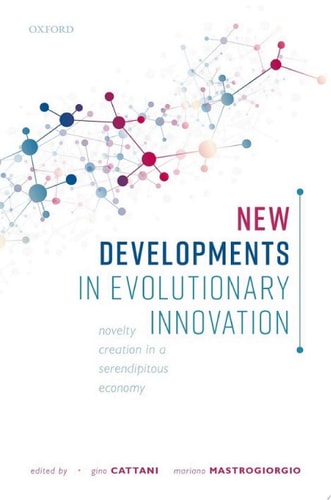
New Developments in Evolutionary Innovation: Novelty Creation in a Serendipitous Economy
0
0
As an Amazon Associate and affiliate partner, Menrva Books earns from qualifying purchases. Learn more
Author Description
The growth of evolutionary thinking has had a profound impact on economic theory and related fields such as strategy and technological innovation. An important paradigm that underlies the evolutionary theory of innovation is neo-Darwinian evolution. According to this paradigm, evolution is gradualist and based on the mechanisms of variation, selection, and retention. Since the 1970s, theoretical advancements in evolutionary biology have recognised the central role of punctuated equilibrium, speciation, and exaptation. However, despite their significant influence in evolutionary biology, these advancements have been reflected only partially in evolutionary approaches to economics, strategy, and innovation. The aim of this book is to review these advancements and explore their implications, with a particular emphasis on the role of serendipity and unprestateability in innovation and novelty creation.
Menrva's Summary
THE THESIS
This book investigates how modern advancements in evolutionary biology, specifically regarding punctuated equilibrium and exaptation, can be integrated into economic theory to better explain the creation of novelty. Chris Bull examines the limitations of the traditional neo-Darwinian gradualist paradigm within current economic models. By incorporating concepts of serendipity and unprestateability, the author proposes a more robust framework for understanding how innovation occurs in complex, unpredictable market environments.
THE SCOPE MAP
What You Will Find
- Analysis of neo-Darwinian versus modern evolutionary biological frameworks
- Theoretical application of exaptation and speciation to economic strategy
- Examination of serendipity as a driver for technological novelty
- Discussion on the limits of gradualist models in innovation
Scope Limits
- Does not provide a step-by-step manual for corporate innovation management
- Does not cover historical case studies of specific firm-level product development
THE AUTHORITY PERSPECTIVE
Experts view this text as a bridge between biological theory and economic strategy, noting its high level of academic rigor. Readers frequently highlight the density of the prose, suggesting it is best suited for scholars and professionals familiar with evolutionary economics.
Page Count:
244
Publication Date:
2021-01-01
Publisher:
OUP Oxford
ISBN-10:
0192573969
ISBN-13:
9780192573964
Economics
Business Theory
Evolutionary Biology
Innovation Strategy
Community Tags
Similar Books