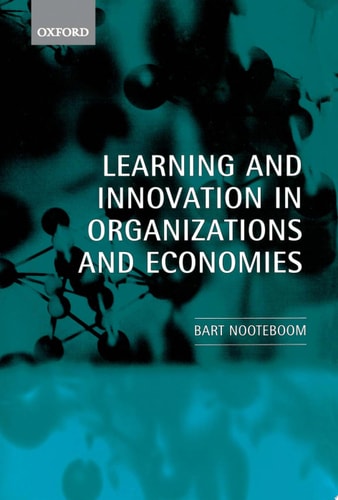
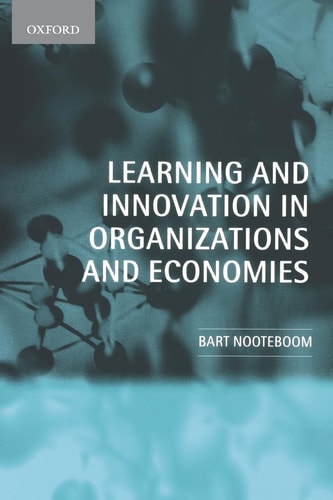
Learning and Innovation in Organizations and Economies
0
0
As an Amazon Associate and affiliate partner, Menrva Books earns from qualifying purchases. Learn more
Author Description
This Book Develops A General 'logic', Or Heuristic Of Discovery, To Explain The Emergence Of Novelty In Individual Thought, Organizations, Industries, And Economies. It Draws On A Variety Of Literatures, Discussing Theories Of Organizational Learning, Evolutionary And Institutional Economics, Knowledge And Language. It Brings These Together In A Unifying Framework, And Applies That For An Analysis Of Innovation Systems And The Management Of Learning. Unification Is Based On The Resource Or Competence-based View In Economics, In Combination With A Theory Of Learning By Interaction. The Central Theme Of The Book Is The Relation Between Stability And Change. In Business Literature This Theme Appears In The Relation Between Exploitation And Exploration. In Evolutionary Economics It Appears In The Relation Between Selection And Adaptation. The General Heuristic Shows How Exploitation Can Provide The Basis For Exploration. The Analysis Is Illustrated With Many Phenomena And Empirical Results From The Different Literatures.
Menrva's Summary
THE THESIS
This book investigates the underlying logic and heuristics of discovery to explain how novelty emerges within individual cognition, organizational structures, and broader economic systems. Bart Nooteboom, an expert in organizational learning and evolutionary economics, synthesizes diverse theoretical perspectives into a unified framework. By integrating the resource-based view of the firm with theories of interactive learning, the author provides a structured approach to understanding the tension between stability and change. The work argues that exploitation of existing knowledge serves as a necessary foundation for the exploration of new ideas.
THE SCOPE MAP
What You Will Find
- A unified heuristic for understanding innovation across multiple scales.
- Theoretical integration of organizational learning, institutional economics, and language theory.
- Analysis of the balance between exploitation and exploration in business and evolutionary contexts.
- Empirical illustrations drawn from various economic and organizational studies.
Scope Limits
- The text focuses on theoretical and heuristic modeling rather than providing a practical step-by-step management manual.
- It does not cover specific industry-wide case studies in exhaustive detail, prioritizing conceptual breadth over narrow sector analysis.
THE AUTHORITY PERSPECTIVE
Experts recognize this work as a significant contribution to the intersection of evolutionary economics and organizational theory. Readers frequently note the academic density of the prose, which is best suited for scholars and advanced students interested in the mechanics of innovation.
Page Count:
362
Publication Date:
2000-01-01
Publisher:
Oup Oxford
ISBN-10:
0191591319
ISBN-13:
9780191591310
Economics
Business Theory
Community Tags
Other Editions(4)


Similar Books