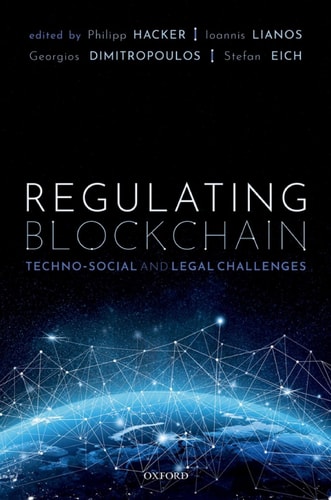
Regulating Blockchain: Techno-Social and Legal Challenges
0
0
As an Amazon Associate and affiliate partner, Menrva Books earns from qualifying purchases. Learn more
Author Description
Less than a decade after the Financial Crisis, we are witnessing the fast emergence of a new financial order driven by three different, yet interconnected, dynamics: first, the rapid application of technology - such as big data, machine learning, and distributed computing - to banking, lending, and investing, in particular with the emergence of virtual currencies and digital finance; second, a disintermediation fuelled by the rise of peer-to-peer lending platforms and crowd investment which challenge the traditional banking model and may, over time, lead to a transformation of the way both retail and corporate customers bank; and, third, a tendency of de-bureaucratisation under which new platforms and technologies challenge established organisational patterns that regulate finance and manage the money supply. These changes are to a significant degree driven by the development of blockchain technology. The aim of this book is to understand the technological and business potential of the blockchain technology and to reflect on its legal challenges. The book mainly focuses on the challenges blockchain technology has so far faced in its first application in the areas of virtual money and finance, as well as those that it will inevitably face (and is partially already facing, as the SEC Investigative Report of June 2017 and an ongoing SEC securities fraud investigation show) as its domain of application expands in other fields of economic activity such as smart contracts and initial coin offerings. The book provides an unparalleled critical analysis of the disruptive potential of this technology for the economy and the legal system and contributes to current thinking on the role of law in harvesting and shaping innovation.
Menrva's Summary
THE THESIS
How can legal systems effectively regulate the disruptive potential of blockchain technology while fostering innovation in finance and beyond? The authors, a team of legal scholars and experts, analyze the intersection of distributed ledger technology with existing regulatory frameworks. They argue that the rapid evolution of virtual currencies and smart contracts necessitates a proactive, critical approach to governance that balances technological advancement with systemic economic stability.
THE SCOPE MAP
What You Will Find
- Analysis of blockchain applications in banking, lending, and investment.
- Examination of the legal implications of smart contracts and initial coin offerings.
- Case studies involving regulatory bodies like the SEC.
Scope Limits
- The text focuses primarily on financial and legal domains, excluding deep technical engineering specifications.
- It does not provide a comprehensive guide for individual cryptocurrency investment strategies.
THE AUTHORITY PERSPECTIVE
Legal scholars and financial analysts frequently cite this work as a foundational text for understanding the early regulatory friction between blockchain and traditional law. Experts highlight the book's academic density and its utility for those navigating the intersection of emerging technology and established institutional policy.
Page Count:
459
Publication Date:
2019-01-01
Publisher:
OUP Oxford
ISBN-10:
0192579509
ISBN-13:
9780192579508
Blockchain
Finance
Regulation
Technology
Law
Professional Career & Trade
Community Tags
Similar Books