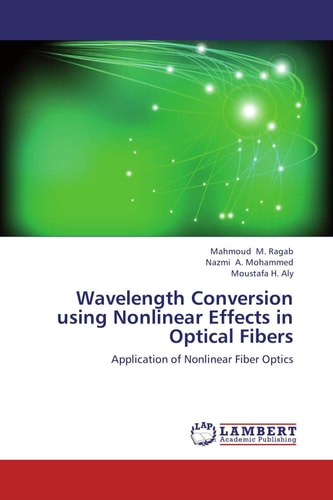
Wavelength Conversion Using Nonlinear Effects in Optical Fibers: Application of Nonlinear Fiber Optics
0
0
As an Amazon Associate and affiliate partner, Menrva Books earns from qualifying purchases. Learn more
Author Description
Wavelength conversion has been acknowledged as one of the most significant optical processing functions. Ultra-high data rate all-optical wavelength conversion is an enabling technology for providing wavelength flexibility, increasing the capacity of photonics networks and enhancing optimized all-optical routing and switching. Several all-optical wavelength conversion approaches have been studied and investigated, which are based on nonlinearities in optical fibers. Nonlinear effects mainly applied in fiber-based wavelength conversion are four wave mixing (FWM) and self phase modulation (SPM), all of which originate from the Kerr effect. However, to make use of this nonlinear phenomenon in optical signal processing, this requires that a suitable fiber be available. In this book, wavelength conversion based on both SPM and FWM at 1550 nm has been demonstrated using different types of fibers. A numerical simulation is used to predict the performance of each type of fiber and to address the potential of each fiber type in wavelength conversion applications.
Menrva's Summary
THE THESIS
This book investigates the critical role of nonlinear effects in optical fibers for achieving efficient all-optical wavelength conversion. The authors explore how phenomena like Four-Wave Mixing (FWM) and Self-Phase Modulation (SPM), both stemming from the Kerr effect, enable ultra-high data rate wavelength conversion. This is presented as a key technology for enhancing the capacity and flexibility of photonic networks. The work details the demonstration of wavelength conversion at 1550 nm using various fiber types, employing numerical simulations to predict and analyze their performance for practical applications.
THE SCOPE MAP
- Detailed explanation of wavelength conversion as a fundamental optical processing function.
- Exploration of nonlinear effects in optical fibers, specifically Four-Wave Mixing (FWM) and Self-Phase Modulation (SPM).
- Discussion of the Kerr effect as the origin of these nonlinear phenomena.
- Demonstration of wavelength conversion at 1550 nm.
- Analysis of different types of optical fibers for their suitability in wavelength conversion.
- Application of numerical simulations to predict fiber performance.
- Focus on enabling wavelength flexibility, increasing network capacity, and optimizing routing and switching in photonic networks.
THE AUTHORITY PERSPECTIVE
The book focuses on the technical aspects of wavelength conversion using nonlinear fiber optics, presenting research and simulations related to FWM and SPM. The methodology relies on numerical predictions of fiber performance, suggesting a strong emphasis on theoretical and computational analysis. The content appears geared towards researchers and engineers in the field of photonics and telecommunications, offering insights into the practical application of nonlinear effects for network enhancement.
Page Count:
104
Publication Date:
2013-01-01
Publisher:
LAP LAMBERT Academic Publishing
ISBN-10:
3659310549
ISBN-13:
9783659310546
Science & Technology
Non-Fiction
Science
Photonics
Engineering
Optics
Telecommunications
Community Tags
Similar Books