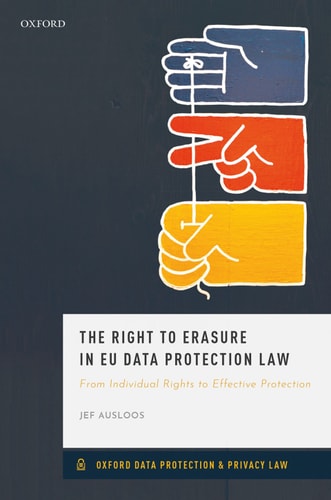
The Right to Erasure in EU Data Protection Law
0
0
As an Amazon Associate and affiliate partner, Menrva Books earns from qualifying purchases. Learn more
Author Description
This book critically investigates the role of data subject rights in countering information and power asymmetries online. It aims at dissecting 'data subject empowerment' in the information society through the lens of the right to erasure ("right to be forgotten") in Article 17 of the General Data Protection Regulation (GDPR). In doing so, it provides an extensive analysis of the interaction between the GDPR and the fundamental right to data protection in Art.8 of the Charter of Fundamental Rights of the EU (Charter), how data subject rights affect fair balancing of fundamental rights, and what the practical challenges are to effective data subject rights. The book starts with exploring the data-driven asymmetries that characterise individuals' relationship with tech giants. These commercial entities increasingly anticipate and govern how people interact with each other and the world around them, affecting core values such as individual autonomy, dignity and freedom. The book explores how data protection law, and data subject rights in particular, enable resisting, breaking down or at the very least critically engaging with these asymmetric relationships. It concludes that despite substantial legal and practical hurdles, the GDPR's right to erasure does play a meaningful role in furthering the fundamental right to data protection (Art. 8 Charter) in the face of power asymmetries online.
Menrva's Summary
THE THESIS
This book investigates whether the right to erasure, as codified in Article 17 of the GDPR, effectively counters information and power asymmetries between individuals and large-scale technology corporations. Jef Ausloos, a legal scholar specializing in data protection, utilizes a doctrinal and socio-legal framework to analyze the intersection of EU data protection law and the fundamental rights enshrined in the Charter of Fundamental Rights of the EU. The work argues that while significant practical and legal barriers exist, the right to erasure serves as a critical mechanism for individual empowerment and the protection of autonomy within the digital information society.
THE SCOPE MAP
What You Will Find
- Detailed legal analysis of Article 17 of the General Data Protection Regulation (GDPR)
- Examination of the relationship between data subject rights and Article 8 of the Charter of Fundamental Rights of the EU
- Investigation into the power dynamics between individual users and dominant technology platforms
- Assessment of the practical implementation challenges regarding data deletion requests
Scope Limits
- Does not provide a comprehensive guide for corporate compliance officers
- Focuses primarily on the EU legal framework rather than comparative global privacy laws
THE AUTHORITY PERSPECTIVE
Legal scholars and privacy practitioners recognize this work as a rigorous examination of the theoretical and practical limitations of the right to be forgotten. Experts frequently highlight the text for its depth in connecting abstract fundamental rights to the concrete realities of modern data-driven power structures.
Page Count:
560
Publication Date:
2020-01-01
Publisher:
OUP Oxford
ISBN-10:
0192587226
ISBN-13:
9780192587220
Technology Law
Digital Rights
Data privacy
Law
Law And Legislation
GDPR
Professional Career & Trade
European Union