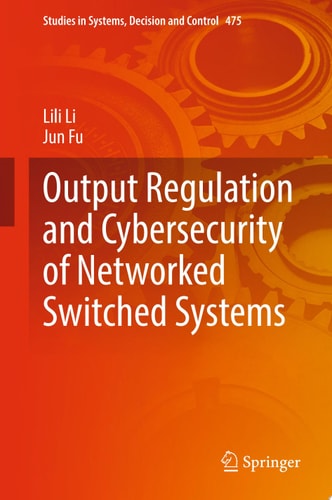
Output Regulation and Cybersecurity of Networked Switched Systems
0
0
As an Amazon Associate and affiliate partner, Menrva Books earns from qualifying purchases. Learn more
Author Description
Networked switched system has emerged as an essential system model in the field of control due to its accurate reflection of the wide-area distribution and typical switching characteristics of increasingly sophisticated controlled objects in engineering practice. The openness of communication networks, the limitation of communication resources, and the complexity of switching behaviors make it a challenging task to ensure the steady-state and transient performance of the output regulation of networked switched systems. This book proposes several novel methodologies for output regulation of networked switched systems from the perspective of both steady-state and transient performance. The core features of our approaches are fourfold: i) Without imposing stability requirements on individual subsystems and all switching instants, a series of innovative dwell-time switching technologies are established to handle the issue of output regulation for networked switched systems with severely unstable dynamics under event-triggering strategies in the presence of cyber attacks. ii) Taking into account switching rules and cyber attack parameters within the event-triggered control framework, event detection conditions, modal matching conditions, and event waiting conditions are constructed, and a series of new event-triggering mechanisms are proposed to effectively enhance network resource utilization and secure steady-state performance of networked switched systems. iii) Typical cyber attacks have unique consequences on the secure steady-state performance of networked switched systems with severely unstable dynamics due to the short activation time of a single subsystem and the necessity to relay the switching signal through the network. To this purpose, the consecutive asynchronous switching behaviors of the subsystem or controller resulting from a long-duration DoS attack or an integrity deception attack incorporating switching signal tampering are investigated. iv) To deal
Menrva's Summary
THE THESIS
This book investigates novel methodologies for ensuring the output regulation of networked switched systems, addressing challenges posed by network openness, resource limitations, and complex switching behaviors. The authors, Jun Fu and LiLi Li, propose several innovative approaches to tackle output regulation from both steady-state and transient performance perspectives. Their methodologies are designed to handle systems with unstable dynamics under event-triggering strategies and cyber attacks, without requiring stability of individual subsystems or at all switching instants. The work focuses on enhancing network resource utilization and secure steady-state performance by considering switching rules and cyber attack parameters within event-triggered control frameworks, and by investigating the impact of consecutive asynchronous switching behaviors resulting from various cyber attacks.
THE SCOPE MAP
- Innovative dwell-time switching technologies for output regulation of networked switched systems with unstable dynamics under event-triggering strategies and cyber attacks.
- Event detection conditions, modal matching conditions, and event waiting conditions constructed within an event-triggered control framework.
- New event-triggering mechanisms to enhance network resource utilization and secure steady-state performance.
- Investigation of consecutive asynchronous switching behaviors due to long-duration DoS attacks or integrity deception attacks.
- Analysis of the impact of cyber attacks on secure steady-state performance in systems with severely unstable dynamics.
- Consideration of switching signal relay through networks and short activation times of subsystems.
THE AUTHORITY PERSPECTIVE
The book presents advanced methodologies for a critical area of control engineering, focusing on the complex challenges of networked switched systems. The authors' approaches are characterized by their innovative use of dwell-time switching technologies and event-triggered control frameworks to address issues like cyber attacks and unstable dynamics. The detailed investigation into the consequences of various cyber attacks on system performance suggests a rigorous and comprehensive treatment of the subject matter. This work is likely to be of significant interest to researchers and practitioners in control theory, network engineering, and cybersecurity.
Page Count:
205
Publication Date:
2023-07-11
Publisher:
Springer Nature
ISBN-10:
3031309723
ISBN-13:
9783031309724
Science
Science & Technology
Non-Fiction
Control systems
Cybersecurity
Engineering
Community Tags
Similar Books









Reader Comments
Share Your Thoughts
No comments yet. Be the first to share your thoughts!