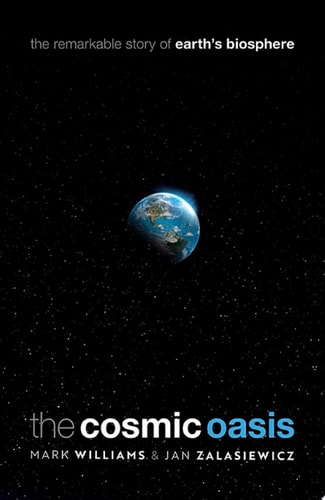
The Cosmic Oasis: The Remarkable Story of Earth's Biosphere
0
0
As an Amazon Associate and affiliate partner, Menrva Books earns from qualifying purchases. Learn more
Author Description
Alone in the known universe the Earth glows bright with life, a unique cosmic oasis of biodiversity which is now under threat from our own actions. The Earth is a unique as a living planet, a cosmic oasis drifting in the vastness of barren space. It is strikingly and obviously different from our nearest heavenly neighbours, the Moon, Venus and Mars, in its thin skin of biology, extending from the surface for a few kilometres into the crust, and for a few tens of kilometres into the air. But how did this remarkable abundance and diversity of life arise? How has life survived over the enormous time frame of Earth's history? And does it continue to flourish now, especially with the growing pressure for space from humans? The Cosmic Oasis examines life on Earth, from our earliest interactions with animals and plants to our absolute domination of biology. It follows our developing understanding of life's origins, its remarkable complexity, and its interactions with the air, oceans and land. It also shows how patterns of diversity across the surface of the planet evolved, and how humans are now homogenising these, degrading both biodiversity and the space in which life can exist. Within this overall trend of loss there are some remarkable examples of survival, from the beneficial relationships between the gelada monkeys and wolves of the Ethiopian highlands, and the people and brown howler monkeys of Porte Allegre in Brazil, to interactions between you and your gut microbiome. Thoughout, the authors ask what these interactions can teach us about building a better relationship with nature, and consider how we might become stewards, rather than destructive exploiters, of the life around us.
Menrva's Summary
THE THESIS
This book investigates the origins, resilience, and current precarious state of Earth's biosphere in the context of human impact. Authors Jan Zalasiewicz and Mark B. Williams, both established geologists and science communicators, synthesize geological history and biological data to argue that Earth's unique status as a living planet is currently threatened by human-driven homogenization. They provide a framework for understanding the planet as a complex, interconnected system where life has historically adapted to environmental shifts, but now faces unprecedented pressure from human activity.
THE SCOPE MAP
What You Will Find
- Historical analysis of life's origins and evolutionary development over geological time.
- Examination of the interactions between biological life and the Earth's atmosphere, oceans, and crust.
- Case studies on symbiotic relationships, such as gelada monkeys and wolves, and the human gut microbiome.
- Discussion on the shift from human interaction with nature to human domination of biological systems.
Scope Limits
- The text does not provide a comprehensive technical manual for conservation biology or specific policy legislation.
- It does not focus on extraterrestrial life beyond using other planets as a comparative baseline for Earth's uniqueness.
THE AUTHORITY PERSPECTIVE
Experts and readers frequently note the accessible yet scientifically rigorous prose that bridges the gap between geology and biology. It is widely regarded as a clear, informative synthesis for those seeking to understand the historical context of the current environmental crisis.
Page Count:
307
Publication Date:
2022-01-01
Publisher:
OUP Oxford
ISBN-10:
019258474X
ISBN-13:
9780192584748
Science
Natural History
Ecology
Biology
Earth Sciences
Earth Science
Community Tags
Similar Books