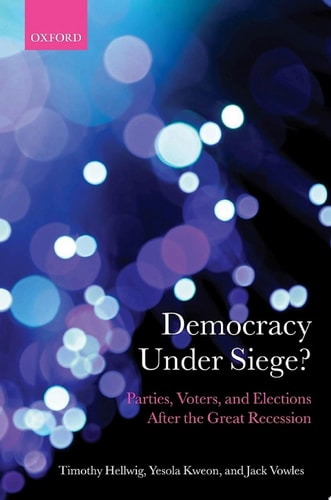
Democracy Under Siege?: Parties, Voters, and Elections After the Great Recession
0
0
As an Amazon Associate and affiliate partner, Menrva Books earns from qualifying purchases. Learn more
Author Description
The Global Financial Crisis of 2008-2009 was catalyst for the most precipitous economic downturn in eight decades. This book examines how the GFC and ensuing Great Recession affected electoral politics in the world's developed democracies. The initial wave of research on the crisis concluded it did little to change the established relationships between voters, parties, and elections. Yet nearly a decade since the initial shock, the political landscape has changed in many ways, the extent to which has not been fully explained by existing studies. Democracy Under Siege? pushes against the received wisdom by advancing a framework for understanding citizen attitudes, preferences, and behaviour. It makes two central claims. First, while previous studies of the GFC tend to focus on an immediate impact of the crisis, Hellwig, Kweon, and Vowles argue that economic malaise has a long lasting impact. In addition to economic shock, the economic recovery has a significant impact on citizens' assessment of political elites. Second, the authors argue that unanticipated exogenous shocks like the GFC grants party elites an opening for political manoeuvre through public policy and rhetoric. As a result, political elites have a high degree of agency to shape public perceptions and behaviour. Political parties can strategically moderate citizens' economic uncertainty, mobilise/demobilise voters, and alter individuals' political preferences. By leveraging data from over 150,000 individuals across over 100 nationally-representative post-election surveys from the 1990s to 2017, this book shows how economic change during a tumultuous era affected economic perceptions, policy demands, political participation, and the vote. The Comparative Study of Electoral Systems (CSES) is a collaborative program of research among election study teams from around the world. Participating countries include a common module of survey questions in their post-election studies. The resulting data are deposited
Menrva's Summary
THE THESIS
This book investigates how the 2008-2009 Global Financial Crisis and its subsequent long-term economic effects fundamentally altered the relationship between voters, political parties, and electoral outcomes in developed democracies. The authors, Timothy Hellwig, Jack Vowles, and Yesola Kweon, utilize an extensive longitudinal dataset to challenge the prevailing academic consensus that the crisis had only a negligible impact on political behavior. They argue that economic malaise and the nature of the recovery provide political elites with significant agency to shape public perception, mobilize voter bases, and redefine policy preferences through strategic rhetoric and maneuvering.
THE SCOPE MAP
What You Will Find
- Longitudinal analysis of electoral politics across developed democracies from the 1990s to 2017.
- A framework for understanding the link between economic uncertainty and political elite agency.
- Quantitative data derived from over 150,000 individual responses across more than 100 nationally-representative post-election surveys.
Scope Limits
- The study focuses primarily on developed democracies and does not provide an exhaustive analysis of developing nations or non-democratic regimes.
- The analysis centers on the impact of the Great Recession and does not cover subsequent global crises occurring after 2017.
THE AUTHORITY PERSPECTIVE
Experts recognize this work as a significant contribution to the Comparative Study of Electoral Systems, providing a rigorous empirical challenge to earlier, more static interpretations of the crisis. Readers frequently note the academic density of the prose and the depth of the statistical methodology employed to support the authors' claims.
Page Count:
243
Publication Date:
2020-01-01
Publisher:
OUP Oxford
ISBN-10:
0192585134
ISBN-13:
9780192585134
Economics
Comparative Politics
Elections
Public Policy
Sociology
Community Tags
Similar Books


Reader Comments
Share Your Thoughts
No comments yet. Be the first to share your thoughts!