Computing Possible Futures
0
0
As an Amazon Associate and affiliate partner, Menrva Books earns from qualifying purchases. Learn more
Author Description
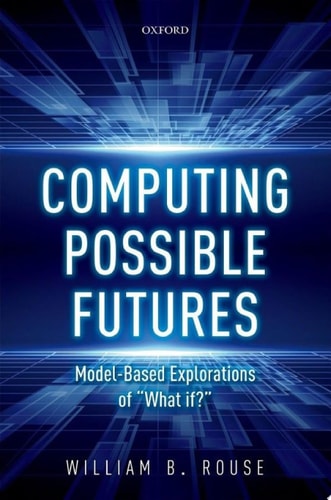
Mathematical modelling and simulation is an increasingly powerful area of mathematics and computer science, which in recent years has been fuelled by the unprecedented access to larger than ever stores of data. These techniques have an increasing number of applications in the professional and political spheres, and people try to predict the results of certain courses of action as accurately as possible. Computing Possible Futures explores the use of models on everyday phenomena such as waiting in lines and driving a car, before expanding the model's complexity to look at how large-scale computational models can help imagine big scale “what-if” scenarios like the effect self-driving cars on the US economy. The successes and failures of complex real world problems are examined, and it is shown how few, if any, failures are due to model errors or computational difficulties. It is also shown how real life decision makers have addressed important problems and used their model-based understanding of possible futures to inform these decisions. Written in an entertaining and accessible way, Computing Possible Futures will help those concerned about the futurity of their decisions to understand what fundamentally needs to be done, why it needs to be done, and how to do it.
Menrva's Summary
THE THESIS
This book investigates how mathematical modeling and computational simulation can be effectively utilized to predict outcomes and inform decision-making in complex, real-world scenarios. Dr. William B. Rouse, an expert in systems engineering and human-systems integration, draws upon his extensive background in research and industry to analyze the intersection of data-driven models and human judgment. He argues that the failures in complex systems are rarely due to computational errors but rather stem from a misunderstanding of how to integrate model-based insights into practical decision-making frameworks.
THE SCOPE MAP
What You Will Find
- Analysis of everyday phenomena such as queueing theory and traffic flow
- Examination of large-scale "what-if" scenarios, including the economic impact of autonomous vehicles
- Case studies of real-world decision makers applying model-based understanding to policy and professional challenges
Scope Limits
- The text does not provide a technical manual for coding specific simulation software
- It does not cover the theoretical proofs of advanced statistical algorithms in isolation from their practical application
THE AUTHORITY PERSPECTIVE
Experts recognize this work as a bridge between high-level computational theory and the practical realities of organizational leadership. Readers frequently note that the prose remains accessible to non-specialists while providing sufficient depth for professionals interested in the mechanics of predictive modeling.
Page Count:
201
Publication Date:
2019-01-01
Publisher:
OUP Oxford
ISBN-10:
0192585444
ISBN-13:
9780192585448
Technology
Decision Making
Data Science
Mathematics - General
Simulation
Mathematics
Mathematics Statistics
Computer Science
Community Tags
Similar Books