Struggles for Belonging: Citizenship in Europe, 1900-2020
0
0
As an Amazon Associate and affiliate partner, Menrva Books earns from qualifying purchases. Learn more
Author Description
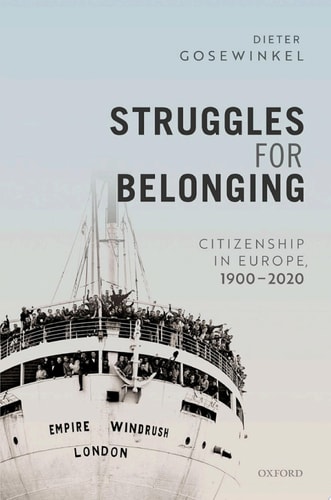
Citizenship was the most important mark of political belonging in Europe in the twentieth century, while estate, religion, party, class, and nation lost political significance in the century of extremes. This is shown by examining the legal institution of citizenship, with its deciding influence on the limits of a political community, on inclusion and exclusion. Citizenship determined a person's protection, equality, and freedom and thus his or her chances in life and very survival. This book recounts the history of citizenship in Europe as the history of European statehood in the twentieth and early twenty-first centuries. It does so from three vantage points: as the development of a legal institution crucial to European constitutionalism; as a measure of an individual's opportunities for self-fulfilment ranging from freedom to totalitarian subjugation; and as a succession of alternating, often sharply divergent political regimes, considered from the perspective of their inclusivity and exclusivity, and its justification. The European history of citizenship is discussed in this book on the basis of six selected countries: Great Britain, France, Germany, Czechoslovakia, Poland, and Russia. For the first time, a joint history of citizenship in Western and Eastern Europe is told here, from the heyday of the nation state to our present day, which is marked by the crises of the European Union. It is the history of a central legal institution that significantly represents and at the same time determines struggles over migration, integration, and belonging. One of the central concerns of this book is what lessons can be learned when it comes to the future chances of European citizenship.
Menrva's Summary
THE THESIS
This book investigates how citizenship functioned as the primary mechanism of political belonging and exclusion in Europe throughout the twentieth and early twenty-first centuries. Dieter Gosewinkel, a scholar of legal and political history, utilizes a comparative framework to analyze the evolution of citizenship across six distinct European nations. He argues that the legal institution of citizenship serves as a critical lens for understanding the broader history of European statehood, constitutional development, and the shifting boundaries of inclusion and exclusion.
THE SCOPE MAP
What You Will Find
- Comparative analysis of citizenship laws in Great Britain, France, Germany, Czechoslovakia, Poland, and Russia.
- Examination of citizenship as a determinant of individual rights, protection, and life chances.
- Historical synthesis of Western and Eastern European legal traditions from 1900 to 2020.
- Discussion of the impact of political regimes, from democratic constitutionalism to totalitarianism, on citizenship status.
Scope Limits
- The study focuses on six specific nations and does not provide an exhaustive survey of every European country.
- The analysis prioritizes legal and political institutional history over grassroots social movements or individual personal narratives.
THE AUTHORITY PERSPECTIVE
Experts recognize this work as a significant contribution to the comparative history of European statehood and legal development. Readers frequently note the academic density of the prose, which provides a rigorous examination of how citizenship structures have shaped political identity across the continent.
Page Count:
540
Publication Date:
2021-01-01
Publisher:
OUP Oxford
ISBN-10:
0192585061
ISBN-13:
9780192585066
History
Citizenship Studies
Law
Professional Career & Trade
Sociology
European History
Community Tags
Similar Books