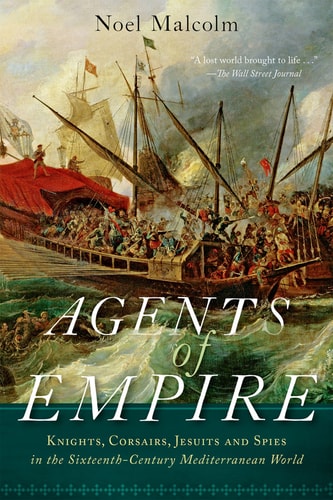
Agents of Empire: Knights, Corsairs, Jesuits, and Spies in the Sixteenth-Century Mediterranean World
0
0
As an Amazon Associate and affiliate partner, Menrva Books earns from qualifying purchases. Learn more
Author Description
In the late sixteenth century, a prominent Albanian named Antonio Bruni composed a revealing document about his home country. Historian Sir Noel Malcolm takes this document as a point of departure to explore the lives of the entire Bruni family, whose members included an archbishop of the Balkans, the captain of the papal flagship at the Battle of Lepanto--at which the Ottomans were turned back in the Eastern Mediterranean--in 1571, and a highly placed interpreter in Istanbul, formerly Constantinople, the capital of the Eastern Roman Empire that fell to the Turks in 1453. The taking of Constantinople had profoundly altered the map of the Mediterranean. By the time of Bruni's document, Albania, largely a Venetian province from 1405 onward, had been absorbed into the Ottoman Empire. Even under the Ottomans, however, this was a world marked by the ferment of the Italian Renaissance.In Agents of Empire, Malcolm uses the collective biography of the Brunis to paint a fascinating and intimate picture of Albania at a moment when it represented the frontier between empires, cultures, and religions. The lives of the polylingual, cosmopolitan Brunis shed new light on the interrelations between the Ottoman and Christian worlds, characterized by both conflict and complex interdependence. The result of years of archival detective work, Agents of Empire brings to life a vibrant moment in European and Ottoman history, challenging our assumptions about their supposed differences. Malcolm's book guides us through the exchanges between East and West, Venetians and the Ottomans, and tells a story of worlds colliding with and transforming one another.
Menrva's Summary
THE THESIS
How did the lives of a single, interconnected family reflect the complex geopolitical and cultural shifts occurring on the frontier between the Ottoman and Christian worlds during the sixteenth century? Historian Sir Noel Malcolm utilizes the archival records of the Bruni family to examine the fluid boundaries of the Mediterranean during a period of intense imperial transition. By tracing the careers of family members who served as diplomats, military commanders, and religious figures, Malcolm argues that the divide between East and West was far more porous and interdependent than traditional historical narratives suggest.
THE SCOPE MAP
What You Will Find
- A detailed reconstruction of the Bruni family lineage and their professional roles in Albania, Venice, and Istanbul.
- Analysis of the geopolitical impact of the fall of Constantinople and the subsequent Ottoman expansion.
- Examination of the Battle of Lepanto and its role in shaping Mediterranean power dynamics.
- Primary source research derived from sixteenth-century documents and correspondence.
Scope Limits
- The study focuses primarily on the specific experiences of the Bruni family and their immediate social circle rather than providing a comprehensive military history of the entire Ottoman-Christian conflict.
THE AUTHORITY PERSPECTIVE
Historians and scholars frequently cite this work as a model of microhistory for its ability to synthesize archival rigor with a compelling narrative structure. Experts highlight the text as a significant contribution to Mediterranean studies that effectively challenges binary perceptions of Ottoman and European relations.
Page Count:
640
Publication Date:
2019-09-01
Publisher:
Oxford University Press
ISBN-10:
019005672X
ISBN-13:
9780190056728
History
Biography
Turkey
Renaissance
Ottoman Empire
European History
New Used & Rental Textbooks
World
Middle East
Europe
Community Tags
Similar Books