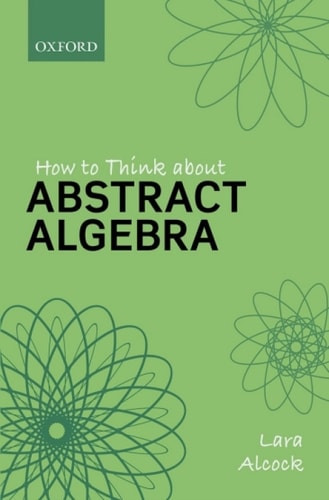
How to Think About Abstract Algebra
0
0
As an Amazon Associate and affiliate partner, Menrva Books earns from qualifying purchases. Learn more
Author Description
How to Think about Abstract Algebra provides an engaging and readable introduction to its subject, which encompasses group theory and ring theory. Abstract Algebra is central in most undergraduate mathematics degrees, and it captures regularities that appear across diverse mathematical structures - many people find it beautiful for this reason. But its abstraction can make its central ideas hard to grasp, and even the best students might find that they can follow some of the reasoning without really understanding what it is all about. This book aims to solve that problem. It is not like other Abstract Algebra texts and is not a textbook containing standard content. Rather, it is designed to be read before starting an Abstract Algebra course, or as a companion text once a course has begun. It builds up key information on five topics: binary operations, groups, quotient groups, isomorphisms and homomorphisms, and rings. It provides numerous examples, tables and diagrams, and its explanations are informed by research in mathematics education. The book also provides study advice focused on the skills that students need in order to learn successfully in their own Abstract Algebra courses. It explains how to interact productively with axioms, definitions, theorems and proofs, and how research in psychology should inform our beliefs about effective learning.
Menrva's Summary
THE THESIS
This book investigates the cognitive and pedagogical barriers that prevent undergraduate students from grasping the core concepts of abstract algebra. Author Lara Alcock, a researcher in mathematics education, utilizes findings from psychology and instructional design to provide a bridge between introductory mathematics and the high-level abstraction required for group and ring theory. The text serves as a conceptual framework designed to prepare students for the rigors of formal mathematical reasoning rather than functioning as a traditional problem-set textbook.
THE SCOPE MAP
What You Will Find
- Conceptual explanations of binary operations, groups, quotient groups, isomorphisms, homomorphisms, and rings.
- Methodological advice on reading and constructing mathematical proofs.
- Pedagogical strategies for interacting with axioms and definitions.
- Research-based insights into effective learning habits and cognitive psychology.
Scope Limits
- The text does not provide a comprehensive set of exercises or a full curriculum for a standard university course.
- It does not cover advanced topics beyond the foundational elements of group and ring theory.
THE AUTHORITY PERSPECTIVE
Educators and students frequently highlight this text as a valuable supplementary resource for demystifying the transition to abstract mathematical thinking. Experts note that the prose is accessible and effectively addresses common student misconceptions regarding formal proof structures.
Page Count:
320
Publication Date:
2021-01-01
Publisher:
OUP Oxford
ISBN-10:
0192581422
ISBN-13:
9780192581426
Study Skills
Mathematics
Education
Earth Sciences
Community Tags
Similar Books