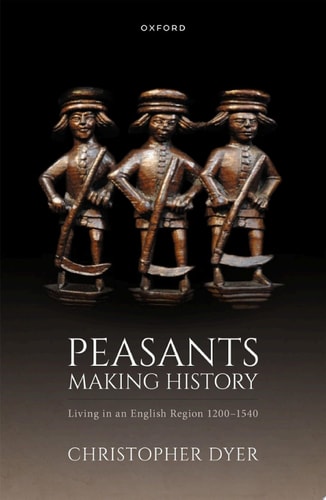
Peasants Making History: Living In an English Region 1200-1540
0
0
As an Amazon Associate and affiliate partner, Menrva Books earns from qualifying purchases. Learn more
Author Description
Peasants have been despised, underrated, or disregarded in the past. Historians and archaeologists are now giving them a more positive assessment, and in Peasants Making History, Christopher Dyer sets a new agenda for this kind of study. Using as his example the peasants of the west midlands of England, Dyer examines peasant society in relation to their social superiors (their lords), their neighbours, and their households, and finds them making decisions and taking options to improve their lives. In their management of farming, both cultivation of fields and keeping of livestock, they made a series of modifications and some dramatic changes, not just reacting to shifts in circumstances but also devising creative initiatives. Peasants played an active role in the development of towns, both by migrating into urban settings, but also by trading actively in urban markets. Industry in the countryside was not imposed on the rural population, but often the result of peasant enterprise and flexibility. If we examine peasant attitudes and mentalities, we find them engaging in political life, making a major contribution to religion, recognizing the need to conserve the environment, and balancing the interests of individuals with those of the communities in which they lived. Many features of our world have medieval roots, and peasants played an important part in the development of the rural landscape, participation of ordinary people in government, parish church buildings, towns, and social welfare. The evidence to support this peasant-centred view has to be recovered by imaginative interpretation, and by using every type of source, including the testimony of archaeology and landscape.
Menrva's Summary
THE THESIS
This book investigates the active role of the medieval peasantry in shaping the economic, social, and political landscape of England between 1200 and 1540. Christopher Dyer, a prominent historian of the medieval period, utilizes a wealth of archival records and archaeological evidence from the West Midlands to challenge the traditional view of peasants as passive subjects. He argues that these individuals were dynamic agents who exercised significant autonomy in their agricultural practices, urban engagement, and community governance.
THE SCOPE MAP
What You Will Find
- Analysis of peasant agricultural management, including field cultivation and livestock strategies.
- Examination of the relationship between rural populations and their lords, neighbors, and households.
- Evidence of peasant involvement in urban development, market trading, and rural industry.
- Discussion of peasant mentalities regarding politics, religion, and environmental conservation.
Scope Limits
- The study is geographically focused on the West Midlands region of England.
- The analysis is bounded by the chronological period of 1200 to 1540.
THE AUTHORITY PERSPECTIVE
Historians recognize this work as a significant contribution to social history that successfully shifts the focus from elite narratives to the agency of the common person. Scholars frequently note that Dyer's methodology provides a model for interpreting fragmented archaeological and documentary evidence to reconstruct the lives of non-literate populations.
Page Count:
395
Publication Date:
2022-01-01
Publisher:
OUP Oxford
ISBN-10:
019258653X
ISBN-13:
9780192586537
History
Archaeology
Europe
British History
Special Topics
Social History
Community Tags
Similar Books