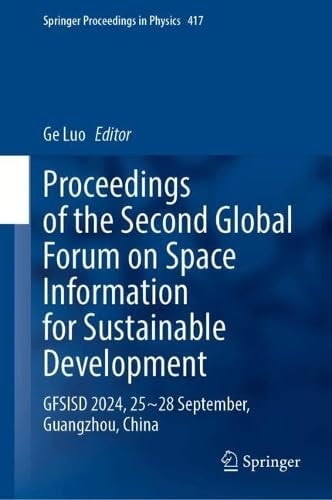
Proceedings of the Second Global Forum on Space Information for Sustainable Development GFSISD 2024, 25–28 September, Guangzhou, China
0
0
As an Amazon Associate and affiliate partner, Menrva Books earns from qualifying purchases. Learn more
Author Description
This proceedings book gathers the latest research presented at the Second Global Forum on Space Information for Sustainable Development (GFSISD 2024) which hosted by China Association of Remote Sensing Application (CARSA), supported by Guangzhou Association For Science & Technology and took place in Guangzhou, Guangdong Province, China, from September 25th to 28th, 2024”. The forum aimed to investigate the important role of remote sensing in fostering environmental conservation and sustainable development. Both the forum and this proceedings volume address interdisciplinary areas including space information, earth system science, social sciences, economics, and sustainable development. It highlights the enhanced application of spatial information and big data derived from remote sensing in areas such as climate change response, disaster risk reduction, food security, energy and resource management, environmental protection, biodiversity preservation, public health, traffic management, and ocean monitoring. The book provides extensive coverage of three specific goals within the United Nations' 2030 Agenda for Sustainable Development: Goal 2—Zero Hunger, which encompasses sustainable agriculture; Goal 14—Life Below Water, which emphasizes the sustainable use of marine resources; and Goal 15—Life On Land, which focuses on the sustainable use of terrestrial ecosystems. Furthermore, the publication covers the methodologies and applications of remote sensing sensors (both optical and radar) that contribute to sustainability efforts. Contributors to these proceedings include distinguished scholars and industry leaders from across the globe. This collection serves as a valuable resource for researchers, students, professionals, and policymakers involved in space science, information science, earth and environmental sciences, and sustainable development.
Menrva's Summary
THE THESIS
This collection investigates the application of space information and remote sensing technologies to address global sustainable development challenges. The proceedings compile research presented at the Second Global Forum on Space Information for Sustainable Development (GFSISD 2024), focusing on interdisciplinary areas spanning space information, earth system science, social sciences, economics, and sustainable development. It highlights the enhanced application of spatial information and big data derived from remote sensing in critical areas such as climate change response, disaster risk reduction, food security, resource management, environmental protection, and biodiversity preservation. The book specifically addresses UN Sustainable Development Goals 2, 14, and 15, detailing methodologies and applications of optical and radar remote sensing sensors.
THE SCOPE MAP
- Latest research on the role of remote sensing in environmental conservation and sustainable development.
- Interdisciplinary coverage of space information, earth system science, social sciences, economics, and sustainable development.
- Enhanced applications of spatial information and big data in climate change response, disaster risk reduction, food security, energy and resource management, environmental protection, biodiversity preservation, public health, traffic management, and ocean monitoring.
- Detailed examination of UN Sustainable Development Goals 2 (Zero Hunger), 14 (Life Below Water), and 15 (Life On Land).
- Methodologies and applications of both optical and radar remote sensing sensors for sustainability efforts.
- Contributions from distinguished scholars and industry leaders globally.
THE AUTHORITY PERSPECTIVE
This collection serves as a valuable resource for researchers, students, professionals, and policymakers involved in space science, information science, earth and environmental sciences, and sustainable development. The forum's aim to investigate the important role of remote sensing in fostering environmental conservation and sustainable development is directly reflected in the breadth of topics covered. The inclusion of contributions from distinguished scholars and industry leaders globally suggests a high level of expertise and diverse perspectives within the volume. The focus on specific UN Sustainable Development Goals indicates a practical and policy-relevant approach to current global challenges.
Page Count:
264
Publication Date:
2025-04-28
Publisher:
Springer Nature Singapore
ISBN-10:
9819624894
ISBN-13:
9789819624898
Science & Technology
Non-Fiction
Science
Biodiversity
Big data
Remote sensing
Environment
Climate Change
Food security
Public Health
Community Tags
Similar Books