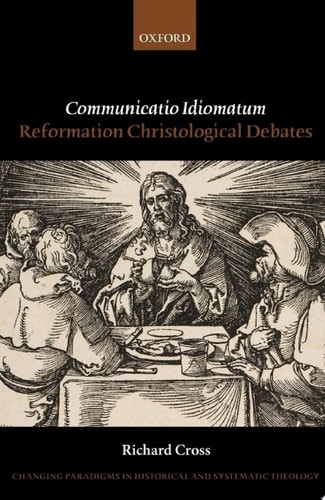
Communicatio Idiomatum: Reformation Christological Debates
0
0
As an Amazon Associate and affiliate partner, Menrva Books earns from qualifying purchases. Learn more
Author Description
This study offers a radical reinterpretation of the sixteenth-century Christological debates between Lutheran and Reformed theologians on the ascription of divine and human predicates to the person of the incarnate Son of God (the communicatio idiomatum). It does so by close attention to the arguments deployed by the protagonists in the discussion, and to the theologians' metaphysical and semantic assumptions, explicit and implicit. It traces the central contours of the Christological debates, from the discussion between Luther and Zwingli in the 1520s to the Colloquy of Montbéliard in 1586. Richard Cross shows that Luther's Christology is thoroughly Medieval, and that innovations usually associated with Luther-in particular, that Christ's human nature comes to share in divine attributes-should be ascribed instead to his younger contemporary Johannes Brenz. The discussion is highly sensitive to the differences between the various Luther groups-followers of Brenz, and the different factions aligned in varying ways with Melanchthon-and to the differences between all of these and the Reformed theologians. By locating the Christological discussions in their immediate Medieval background, Cross also provides a comprehensive account of the continuities and discontinuities between the two eras. In these ways, it is shown that the standard interpretations of the Reformation debates on the matter are almost wholly mistaken.
Menrva's Summary
THE THESIS
This study investigates the historical and metaphysical foundations of the sixteenth-century Christological debates regarding the communicatio idiomatum between Lutheran and Reformed theologians. Prof. Richard Cross, a scholar of medieval and reformation theology, utilizes a rigorous analysis of primary source arguments and semantic assumptions to challenge established interpretations of these debates. By situating the discourse within its medieval context, the author argues that standard historical narratives regarding the origins of specific Lutheran Christological innovations are largely inaccurate.
THE SCOPE MAP
What You Will Find
- A detailed examination of the communicatio idiomatum from the 1520s through the 1586 Colloquy of Montbéliard.
- Comparative analysis of the theological positions held by Luther, Zwingli, Johannes Brenz, and Philipp Melanchthon.
- An investigation into the metaphysical and semantic frameworks underpinning sixteenth-century Christological arguments.
Scope Limits
- The text does not provide a general history of the Reformation beyond the specific scope of Christological debates.
- It does not address modern ecumenical developments or contemporary applications of these theological concepts.
THE AUTHORITY PERSPECTIVE
Scholars and theologians recognize this work as a significant revisionist study that demands a re-evaluation of traditional Reformation historiography. Readers frequently note the academic density of the prose and the high level of technical proficiency required to engage with the author's metaphysical arguments.
Page Count:
312
Publication Date:
2019-01-01
Publisher:
OUP Oxford
ISBN-10:
0192586270
ISBN-13:
9780192586278
Religion
History
Theology
Metaphysics
Reformation History
Systematic Theology
Christology
Christian History
Community Tags
Similar Books