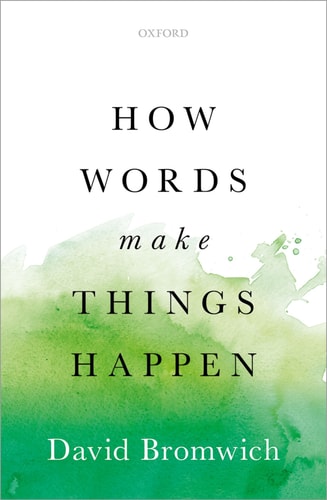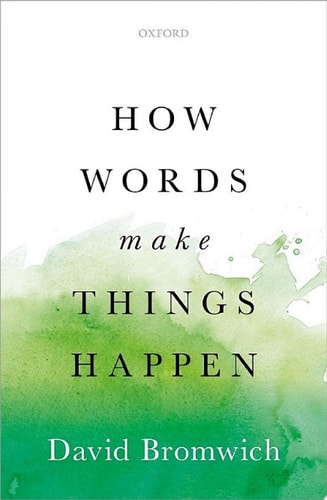
How Words Make Things Happen
0
0
As an Amazon Associate and affiliate partner, Menrva Books earns from qualifying purchases. Learn more
Author Description
Sooner or later, our words take on meanings other than we intended. How Words Make Things Happen suggests that the conventional idea of persuasive rhetoric (which assumes a speaker's control of calculated effects) and the modern idea of literary autonomy (which assumes that 'poetry makes nothing happen') together have produced a misleading account of the relations between words and human action. Words do make things happen. But they cannot be counted on to produce the result they intend. This volume studies examples from a range of speakers and writers and offers close readings of their words. Chapter 1 considers the theory of speech-acts propounded by J.L. Austin. 'Speakers Who Convince Themselves' is the subject of chapter 2, which interprets two soliloquies by Shakespeare's characters and two by Milton's Satan. The oratory of Burke and Lincoln come in for extended treatment in chapter 3, while chapter 4 looks at the rival tendencies of moral suasion and aestheticism in the poetry of Yeats and Auden. The final chapter, a cause of controversy when first published in the London Review of Books, supports a policy of unrestricted free speech against contemporary proposals of censorship. Since we cannot know what our own words are going to do, we have no standing to justify the banishment of one set of words in favour of another.
Menrva's Summary
THE THESIS
This volume investigates the complex relationship between language and human action, challenging the assumption that speakers maintain control over the effects of their words. David Bromwich, a noted scholar of literature and political thought, critiques both the traditional view of persuasive rhetoric and the modern concept of literary autonomy. By examining the inherent unpredictability of language, he argues that while words undeniably influence reality, they frequently produce outcomes unintended by their authors.
THE SCOPE MAP
What You Will Find
- Analysis of J.L. Austin’s speech-act theory
- Interpretations of soliloquies by Shakespeare and Milton
- Comparative studies of oratory by Edmund Burke and Abraham Lincoln
- Examination of moral suasion and aestheticism in the works of W.B. Yeats and W.H. Auden
- A defense of unrestricted free speech based on the unpredictability of linguistic impact
Scope Limits
- Does not provide a comprehensive history of rhetoric
- Does not address non-Western linguistic traditions or non-literary forms of communication
THE AUTHORITY PERSPECTIVE
Critics and scholars frequently note the intellectual rigor and dense analytical prose Bromwich employs to bridge the gap between literary theory and political philosophy. Experts highlight this work as a significant contribution to the ongoing debate regarding the limits of censorship and the social function of language.
Page Count:
129
Publication Date:
2019-01-01
Publisher:
OUP Oxford
ISBN-10:
0192581929
ISBN-13:
9780192581921
Non-Fiction
English
Philosophy of
Rhetoric
Literary Criticism
English & College Success
Political Theory