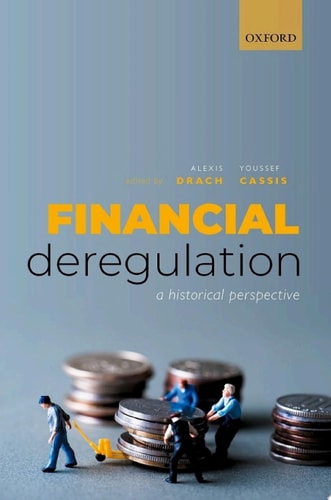
Financial Deregulation: A Historical Perspective
0
0
As an Amazon Associate and affiliate partner, Menrva Books earns from qualifying purchases. Learn more
Author Description
A wave of liberalization swept the developed world at end of the twentieth century. From the 1970s and 1980s onwards, most developed countries have passed various measures to liberalize and modernize the financial markets. Each country had its agenda, but most of them have experienced, to a different extent, a change in regulatory regime. This change, often labeled deregulation and associated with the advent of neoliberalism, was sharply contrasting with the previous era of the Bretton Woods system, which has sometimes been portrayed as an era of financial repression. On the other hand, a quick glance at financial regulation today - at the amount of paper it produces, at its complexity, at the number of people involved, and at the resources invested in it - is enough to say that, somehow, there is more regulation today than ever before. In the new system, financial regulation has taken unprecedented importance. As more archival material is becoming available, a better understanding of the fundamental changes in the regulatory environment towards the end of the twentieth century is now possible. What kind of change exactly was deregulation? Did competition between financial regulators lead to a race to the bottom in regulation? Is deregulation responsible for the recurring financial crises which seem to have characterised the international financial system since the 1980s? The movement towards a more liberal regulatory regime was neither linear nor simple. This book - a collection of chapters studying deregulation in various countries and contexts - examines the national and international pathways of deregulation by providing an in-depth analysis of a short but crucial period in a few major countries.
Menrva's Summary
THE THESIS
This book investigates the nature and consequences of financial deregulation during the late twentieth century to determine whether the shift from the Bretton Woods system constituted a genuine reduction in oversight or a transformation in regulatory complexity. The author compiles a series of scholarly chapters that analyze the transition from the post-war era of financial repression to the neoliberal frameworks of the 1970s and 1980s. By utilizing newly accessible archival materials, the text evaluates whether competition between regulators triggered a race to the bottom and assesses the correlation between these policy shifts and the subsequent rise in international financial crises.
THE SCOPE MAP
What You Will Find
- Comparative analysis of regulatory regime changes across multiple major nations.
- Examination of the transition from the Bretton Woods system to modern neoliberal financial structures.
- Historical investigation into the causality between deregulation and recurring financial instability.
Scope Limits
- The text focuses on a specific, short period in the late twentieth century rather than providing a comprehensive history of all financial regulation.
- It does not offer a universal theory of regulation, instead relying on country-specific case studies.
THE AUTHORITY PERSPECTIVE
Experts identify this collection as a valuable resource for understanding the nuances of financial history and the evolution of regulatory policy. Readers frequently note the academic density of the prose, which is intended for students and professionals interested in the structural shifts of global financial markets.
Page Count:
208
Publication Date:
2021-01-01
Publisher:
OUP Oxford
ISBN-10:
0192598961
ISBN-13:
9780192598967
Economics
History
Principles of Macroeconomics
Finance
Public Policy
Community Tags
Similar Books