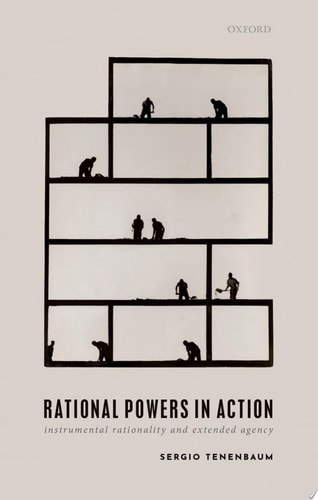
Rational Powers in Action
0
0
As an Amazon Associate and affiliate partner, Menrva Books earns from qualifying purchases. Learn more
Author Description
Human Actions Unfold Over Time, In Pursuit Of Ends That Are Not Fully Specified In Advance. Rational Powers In Action Locates These Features Of The Human Condition At The Heart Of A New Theory Of Instrumental Rationality. Where Many Theories Of Rational Agency Focus On Instantaneous Choices Between Sharply Defined Outcomes, Treating The Temporally Extended And Partially Open-ended Character Of Action As An Afterthought, This Book Argues That The Deep Structure Of Instrumental Rationality Can Only Be Understood If We See How It Governs The Pursuit Of Long-term, Indeterminate Ends. These Are Ends That Cannot Be Realized Through A Single Momentary Action, And Whose Content Leaves Partly Open What Counts As Realizing The End. Sergio Tenenbaum Argues That We Need To Focus On Temporal Duration And The Indeterminacy Of Ends In Intentional Action, Even To Explain The Rational Governance Of Relatively Simple Actions. Theories Of Moment-by-moment Preference Maximization, Or Indeed Any Understanding Of Instrumental Rationality On The Basis Of Momentary Mental Items, Cannot Capture The Fundamental Structure Of Our Instrumentally Rational Capacities. Tenenbaum Provides A New Theory Of Instrumental Rationality As Rationality In Action.
Menrva's Summary
THE THESIS
How can a theory of instrumental rationality account for human actions that unfold over time toward indeterminate ends? Sergio Tenenbaum, a professor of philosophy, challenges traditional models that prioritize instantaneous choice by proposing that rationality is fundamentally a temporal process. He argues that because human ends are often long-term and partially open-ended, instrumental rationality must be understood as a capacity that governs the ongoing pursuit of these goals rather than a series of momentary preference maximizations.
THE SCOPE MAP
What You Will Find
- A critique of standard decision-theoretic models of agency.
- A framework for understanding intentional action as a temporally extended process.
- Analysis of how indeterminate ends influence the rational structure of simple and complex actions.
Scope Limits
- The text does not provide a comprehensive guide to moral philosophy or normative ethics.
- It does not address empirical psychological studies on impulse control or cognitive bias.
THE AUTHORITY PERSPECTIVE
Philosophers and scholars of agency recognize this work as a significant contribution to the debate surrounding instrumental rationality and the nature of intentionality. Readers frequently note the academic density of the prose, which requires a strong background in analytic philosophy to fully grasp the nuances of the author's argument.
Page Count:
224
Publication Date:
2020-01-01
Publisher:
Oxford University Press
ISBN-10:
0192592262
ISBN-13:
9780192592262
Philosophy
Metaphysics
Ethics
Rationality
Action theory
Community Tags
Similar Books