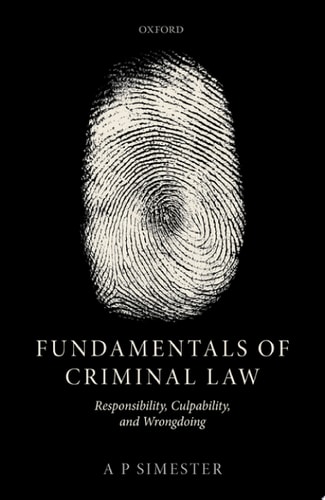
Fundamentals of Criminal Law
0
0
As an Amazon Associate and affiliate partner, Menrva Books earns from qualifying purchases. Learn more
Author Description
Written By A Noted Expert In Criminal Law, This Book Explores The Philosophical Underpinnings Of The Law's Major Doctrines Concerning Actus Reus, Mens Rea, And Defences, Showing That They Are Not Always Driven By Culpability. They Are Grounded Also In Principles Of Moral Responsibility, Ascriptive Responsibility, And Wrongdoing. As Such, They Engage Wider Debates About Wrongdoing, And About The Boundaries Between Liability And Freedom. This Multi-textured Analysis Allows This Book To Take More Nuanced Positions About Many Important Controversies In Criminal Law. It Argues, For Example, That Liability For Omissions And For Negligence-and Even Some Strict Liability Elements-can Sometimes Be Legitimate Yet, At The Same Time, Should Be Relatively Rare. It Also Explains Why Principles Of Causation Can Differ In The Criminal Law From Other Contexts; What Is Wrong With The 'voluntary Act' Requirement; And Why Luck Can Affect The Wrongs We Commit Without Changing Our Degree Of Blameworthiness For Committing Them. The Book Concludes With An Account Of The Major Types Of Defences, And Of How They Interact With An Agent's Wrong And Her Underlying Motivations. This Volume Presents A Coherent And Rich Vision Of The Criminal Law That, By Its Sheer Breadth, Makes A Distinctive Contribution To The Literature, Of Interest To Lawyers And Philosophers Alike.
Menrva's Summary
THE THESIS
This book investigates the philosophical foundations of criminal law doctrines to determine whether they are driven solely by culpability or by broader principles of moral and ascriptive responsibility. Andrew Simester, a noted expert in criminal law, utilizes a multi-textured analytical framework to examine the tension between legal liability and individual freedom. By evaluating major doctrines such as actus reus and mens rea, the author argues that criminal law is grounded in complex moral considerations that extend beyond simple blame. The text provides a systematic account of how these legal structures interact with concepts of wrongdoing and human agency.
THE SCOPE MAP
What You Will Find
- Philosophical analysis of actus reus, mens rea, and legal defences
- Examination of liability for omissions, negligence, and strict liability
- Theoretical exploration of causation and the role of luck in criminal responsibility
- Discussion on the boundaries between legal liability and personal freedom
Scope Limits
- Does not serve as a comprehensive casebook or practitioner's manual for specific jurisdictional statutes
- Focuses primarily on theoretical and normative underpinnings rather than procedural application
THE AUTHORITY PERSPECTIVE
Legal scholars and philosophers frequently cite this work for its rigorous conceptual clarity and its ability to bridge the gap between abstract moral theory and practical legal doctrine. Experts highlight this as a significant contribution to the literature that challenges traditional assumptions about the necessity of culpability in criminal law.
Page Count:
544
Publication Date:
2021-01-01
Publisher:
Oxford University Press
ISBN-10:
0192594591
ISBN-13:
9780192594594
Law
Jurisprudence
Ethics
Criminal Law
Community Tags
Similar Books