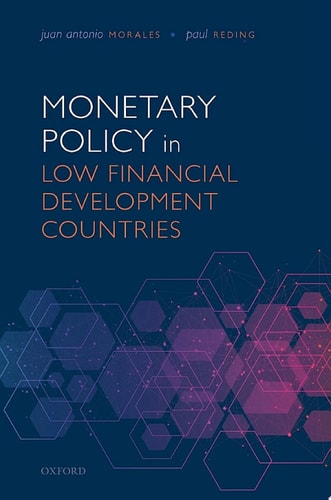
Monetary Policy in Low Financial Development Countries
0
0
As an Amazon Associate and affiliate partner, Menrva Books earns from qualifying purchases. Learn more
Author Description
Monetary Policy in Low Financial Development Countries provides a broad coverage of the monetary policy issues faced by developing countries with low financial depth. These low and lower middle income countries are characterized by the predominance of bank finance, shallow financial markets, low financial inclusion, weak integration with world capital markets, and a high degree of informality in economic activity. Monetary policy acquires special twists, making it different in many aspects from the policies followed in advanced and emerging market economies. This book covers the main facets of monetary policy making, using an approach that combines discussions of theoretical arguments, of results from empirical studies and of relevant policy experiences. It presents the monetary policy instruments that central banks rely on in these countries. It assesses the specificities of their monetary transmission mechanism, i.e. the way central banks' actions affect output and prices. It evaluates the advantages, drawbacks, and challenges of the different nominal anchors they may choose from: exchange rate targeting, monetary targeting, and inflation targeting. This discussion is set against the background of the three main goals pursued by central banks: price, output, and financial stability. Particular attention is devoted to the issue of the credibility of central banks and to the trade-offs they face when external shocks, to which these countries are very vulnerable, lead to conflicts among the three goals they pursue. The authors also cover more specific topics, such as the coordination between monetary and fiscal policy, the challenges raised by dollarization, the implications of informal labour markets and of microfinance institutions for monetary policy-making, as well as the role of models for forecasting and policy evaluation by central banks.
Menrva's Summary
THE THESIS
This book investigates the unique challenges and operational frameworks of monetary policy within developing nations characterized by low financial depth and limited market integration. Juan Antonio Morales and Paul Reding, drawing on their extensive experience in economic policy and research, synthesize theoretical models with empirical evidence to explain how central banks in low-income countries navigate price, output, and financial stability. The authors argue that standard monetary frameworks designed for advanced economies are often insufficient, necessitating a specialized approach that accounts for high informality and weak capital market integration.
THE SCOPE MAP
What You Will Find
- Analysis of monetary transmission mechanisms in bank-dominated economies
- Evaluation of nominal anchors including exchange rate, monetary, and inflation targeting
- Discussion on the coordination between fiscal and monetary authorities
- Examination of specific challenges like dollarization and informal labor markets
Scope Limits
- The text does not provide a comprehensive guide for advanced or emerging market economies with high financial depth
- It does not offer specific country-by-country policy prescriptions but rather a generalized framework for low-income contexts
THE AUTHORITY PERSPECTIVE
Experts identify this work as a significant contribution to development economics, noting its utility for policymakers and researchers operating in constrained financial environments. Readers frequently highlight the clarity with which the authors bridge the gap between abstract macroeconomic theory and the practical realities of central banking in developing nations.
Page Count:
383
Publication Date:
2021-01-01
Publisher:
OUP Oxford
ISBN-10:
0192597027
ISBN-13:
9780192597021
Economics
Finance
Community Tags
Similar Books