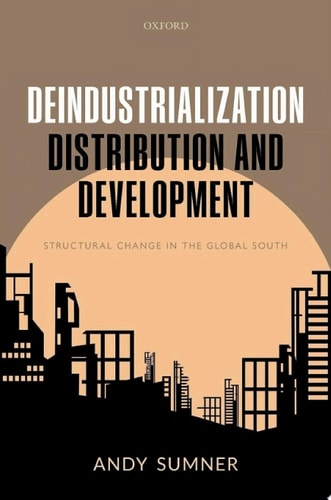
Deindustrialization, Distribution, and Development: Structural Change in the Global South
0
0
As an Amazon Associate and affiliate partner, Menrva Books earns from qualifying purchases. Learn more
Author Description
The term rust belt has rarely been associated with developing countries. In fact, it is commonly used to discuss deindustrialization in advanced nations, particularly the US. However, this book argues that such a belt is now threatening the middle-income developing world, spreading across Brazil and other countries in Latin America, running down across South Africa, and then upwards to Malaysia, Indonesia, Thailand, and the Philippines in South East Asia. Deindustrialization, Distribution, and Development: Structural Change in the Global South explores the emergent processes of stalled industrialization and the spectre of deindustrialization in these developing countries. Building upon the author's previous work on economic development, structural change, and income inequality, this book examines the causes and consequences of these new issues, focusing on inequality both between and within countries since the Cold War. Providing a comparative, in-depth analysis of the varieties of contemporary structural change in the Global South and challenging many long-standing myths, this work explains why late development remains a crucial concept in understanding contemporary development and explores what deindustrialization means for the future of global development.
Menrva's Summary
THE THESIS
This book investigates the phenomenon of premature deindustrialization in middle-income developing nations and its implications for future economic development. Author Andy Sumner, a specialist in international development and poverty, utilizes comparative economic data to challenge the traditional assumption that industrialization is a linear path for all developing countries. He argues that the emergence of a 'rust belt' in the Global South threatens to stall growth and exacerbate income inequality, necessitating a re-evaluation of late development strategies in the post-Cold War era.
THE SCOPE MAP
What You Will Find
- Comparative analysis of structural economic change in Brazil, South Africa, Malaysia, Indonesia, Thailand, and the Philippines.
- Examination of the relationship between deindustrialization and domestic income inequality.
- Theoretical framework for understanding 'stalled industrialization' in middle-income economies.
Scope Limits
- The analysis does not focus on low-income or least-developed countries, concentrating instead on the middle-income tier.
- The text does not provide prescriptive policy manuals for individual nations but focuses on macro-level structural trends.
THE AUTHORITY PERSPECTIVE
Experts in development economics recognize this work as a significant contribution to the discourse on structural change in the Global South. Readers frequently note the academic density of the prose, which is well-suited for researchers and policymakers interested in the shifting landscape of global industrialization.
Page Count:
168
Publication Date:
2021-01-01
Publisher:
OUP Oxford
ISBN-10:
019259446X
ISBN-13:
9780192594464
Economics
Global South
Community Tags
Similar Books