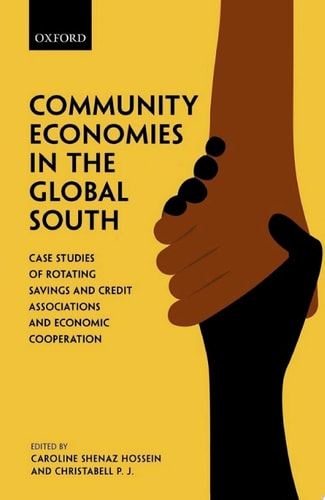
Community Economies in the Global South: Case Studies of Rotating Savings and Credit Associations and Economic Cooperation
0
0
As an Amazon Associate and affiliate partner, Menrva Books earns from qualifying purchases. Learn more
Author Description
People across the globe engage in social and solidarity economics to help themselves, their community, and society on their own terms. Community Economies in the Global South examines how people who conscientiously organize rotating savings and credit associations (ROSCAs) bring positive changes to their own lives as well as others. ROSCAs are a long-established and well documented practice, especially those organized by women of colour. Members make regular deposits to a fund as a savings that is then given in whole or in part to each member in turn based on group economics. This book spotlights women in Latin America, the Caribbean, Africa, and Asia who organize and use these associations, composed of ordinary people belonging to similar class origins who decide jointly on the rules to suit the interests of their members. The case studies show how they vary greatly across countries in the Global South, demonstrating that ROSCAs are living proof that diverse community economies do exist and have been around for a very long time. The contributors recount stories of the self-help, activism, and perseverance of racialized people in order to push for ethical, community-focused business, and to hold onto local knowledge, grounded theory, and lived experience, reducing the need to rely on external funding as people find ways to finance sustainable, debt-free business ventures. The first collection on this topic edited by two women of colour with roots in the Global South, this volume is a rallying call to other scholar-activists to study and report on how racialized people come together, pool goods, and diversify business in the Global South.
Menrva's Summary
THE THESIS
This book investigates how rotating savings and credit associations (ROSCAs) function as sustainable, community-driven economic models that empower marginalized populations in the Global South. The author, Barbara Herman, compiles research and case studies to demonstrate how these grassroots financial structures allow individuals to bypass traditional banking systems, foster local autonomy, and promote ethical business practices. By centering the lived experiences of women of color, the text argues that these associations are not merely survival mechanisms but are sophisticated, long-standing economic systems that challenge conventional development narratives.
THE SCOPE MAP
What You Will Find
- Comparative case studies of ROSCAs across Latin America, the Caribbean, Africa, and Asia.
- Analysis of group-based financial pooling and debt-free business financing models.
- Documentation of self-help, activism, and the preservation of local economic knowledge.
Scope Limits
- The text does not provide a comprehensive global statistical survey of all informal financial systems.
- It does not offer a technical manual for institutionalizing these informal associations into formal banking frameworks.
THE AUTHORITY PERSPECTIVE
Scholars and practitioners in the field of development economics identify this work as a significant contribution to the study of social and solidarity economics. Readers frequently note the accessibility of the case studies, which provide a grounded perspective on economic theory that is often overlooked in traditional academic literature.
Page Count:
288
Publication Date:
2022-01-01
Publisher:
OUP Oxford
ISBN-10:
0192635069
ISBN-13:
9780192635068
Economics
Finance
Community Development
Global South
Sociology
Community Tags
Similar Books