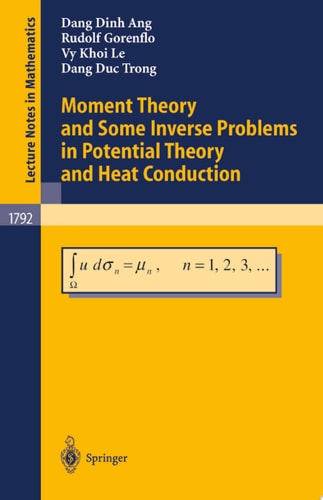
Moment Theory and Some Inverse Problems in Potential Theory and Heat Conduction
0
0
As an Amazon Associate and affiliate partner, Menrva Books earns from qualifying purchases. Learn more
Author Description
Moment Theory is not a new subject; however, in classical treatments, the ill-posedness of the problem is not taken into account - hence this monograph. Assuming a "true" solution to be uniquely determined by a sequence of moments (given as integrals) of which only finitely many are inaccurately given, the authors describe and analyze several regularization methods and derive stability estimates. Mathematically, the task often consists in the reconstruction of an analytic or harmonic function, as is natural from concrete applications discussed (e.g. inverse heat conduction problems, Cauchy's problem for the Laplace equation, gravimetry). The book can be used in a graduate or upper undergraduate course in Inverse Problems, or as supplementary reading for a course on Applied Partial Differential Equations
Menrva's Summary
THE THESIS
This monograph addresses the inherent ill-posedness in classical moment theory by focusing on inverse problems within potential theory and heat conduction. The authors investigate scenarios where a unique solution is determined by a finite, albeit inaccurately provided, sequence of moments. They present and analyze various regularization methods, deriving crucial stability estimates for these problems. The mathematical core involves reconstructing analytic or harmonic functions, drawing direct parallels to practical applications such as inverse heat conduction problems, Cauchy's problem for the Laplace equation, and gravimetry.
THE SCOPE MAP
- Analysis of regularization methods for ill-posed inverse problems.
- Derivation of stability estimates for moment theory applications.
- Reconstruction of analytic and harmonic functions.
- Discussion of inverse heat conduction problems.
- Exploration of Cauchy's problem for the Laplace equation.
- Application to gravimetry.
- Suitable for graduate or upper undergraduate courses in Inverse Problems or Applied Partial Differential Equations.
THE AUTHORITY PERSPECTIVE
The book is presented as a monograph that tackles the ill-posedness often overlooked in classical treatments of moment theory. It focuses on providing rigorous mathematical analysis and practical applications for inverse problems in potential theory and heat conduction. The text is structured to serve as a resource for advanced students and researchers in applied mathematics and mathematical physics, offering methods and stability estimates for reconstructing functions from limited, noisy data.
Page Count:
196
Publication Date:
2014-01-15
Publisher:
Springer
ISBN-10:
3662182920
ISBN-13:
9783662182925
Non-Fiction
Science
Heat conduction
Potential Theory
Mathematical Physics
Applied Mathematics
Community Tags
Similar Books