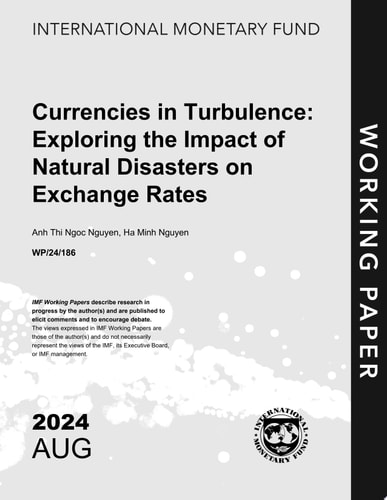
Currencies in Turbulence: Exploring the Impact of Natural Disasters on Exchange Rates
0
0
As an Amazon Associate and affiliate partner, Menrva Books earns from qualifying purchases. Learn more
Author Description
This paper investigates the impact of natural disasters on exchange rate movements in different country groups with different exchange rate regimes. Using a panel local projection model with a high-frequency monthly dataset of 177 countries during 1970M1-2019M12, we find that exchange rate movements are more sensitive to natural disasters in emerging markets and developing countries (EMDEs) than in advanced economies (AEs). Furthermore, exchange rate reactions to natural shocks depend on exchange rate regimes adopted by EMDEs. On average, both nominal and real exchange rates could depreciate up to 6 percents two years after the disasters in non-pegged regimes. Our findings suggest that EMDEs with flexible exchange rate regimes would observe a faster recovery through nominal and real depreciations, although they should be mindful about policy implications that may arise from large exchange rate fluctuations caused by natural disaster shocks.
Menrva's Summary
THE THESIS
This paper investigates the significant impact of natural disasters on exchange rate movements across diverse country groups and exchange rate regimes. The research utilizes a panel local projection model with a high-frequency monthly dataset spanning 177 countries from 1970 to 2019. It reveals that emerging markets and developing economies (EMDEs) exhibit greater sensitivity to natural disasters compared to advanced economies (AEs). The study further details how exchange rate reactions to natural shocks are contingent upon the specific exchange rate regimes adopted by EMDEs.
THE SCOPE MAP
- Analysis of natural disaster impacts on exchange rate movements.
- Comparison of impacts between emerging markets/developing countries (EMDEs) and advanced economies (AEs).
- Examination of the role of different exchange rate regimes within EMDEs.
- Quantification of exchange rate depreciation following natural disasters (up to 6% in non-pegged regimes within two years).
- Discussion of policy implications arising from large exchange rate fluctuations.
- Utilizes a panel local projection model.
- Employs a high-frequency monthly dataset covering 177 countries from 1970M1-2019M12.
THE AUTHORITY PERSPECTIVE
The study's findings suggest that EMDEs with flexible exchange rate regimes may experience a faster recovery through nominal and real depreciations following natural disasters. However, these countries must remain cognizant of potential policy challenges stemming from substantial exchange rate volatility induced by such shocks. The research provides a nuanced understanding of how global economic systems respond to environmental crises, offering valuable insights for policymakers and financial institutions operating in vulnerable regions.
Page Count:
36
Publication Date:
2024-08-30
Publisher:
International Monetary Fund
ISBN-13:
9798400289385
Economics
Non-Fiction
Finance
Community Tags
Similar Books