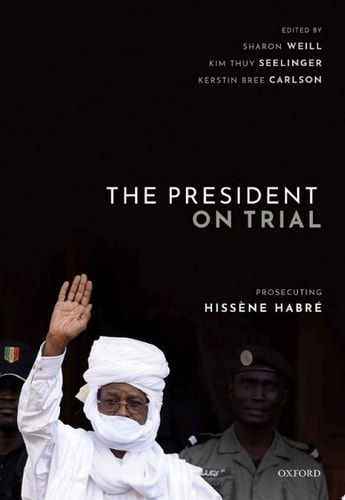
The President on Trial: Prosecuting Hissène Habré
0
0
As an Amazon Associate and affiliate partner, Menrva Books earns from qualifying purchases. Learn more
Author Description
During the 1980s, thousands of Chadian citizens were detained, tortured, and raped by then-President Hissène Habré's security forces. Decades later, Habré was finally prosecuted for his role in these atrocities not in his own country or in The Hague, but across the African continent, at the Extraordinary African Chambers in Senegal. By some accounts, Habré's trial and conviction by a specially built court in Dakar is the most significant achievement of global criminal justice in the past decade. Simply creating a court and commencing a trial against a deposed head of state was an extraordinary success. With its 2016 judgment, affirmed on appeal in 2017, the hybrid tribunal in Senegal exceeded expectations, working to deadlines and within its budget, with no murdered witnesses or self-dealing officials. This book details and contextualizes the Habré trial. It presents the trial and its impact using a novel structure of first-person accounts from 26 direct actors (Part I), accompanied by academic analysis from leading experts on international criminal justice (Part II). Combined, these views present both local and international perspectives through distinct but inter-locking parts: empirical source material from understudied actors both within and outside the court is then contextualized with expert analysis that reflects on the construction and work of: the Extraordinary African Chamber (EAC) as well as wider themes of international criminal law. Together with an introduction laying out the work and significance of the EAC and its trial of Hissène Habré, the book is a comprehensive consideration of a history-making trial.
Menrva's Summary
THE THESIS
This book investigates the legal and political significance of the trial of Hissène Habré, questioning how a hybrid tribunal in Senegal successfully prosecuted a former head of state for atrocities. The authors, Kerstin Bree Carlson, Kim Thuy Seelinger, and Sharon Weill, utilize a dual-methodology approach to evaluate the Extraordinary African Chambers. By combining primary source testimonies with rigorous academic analysis, they argue that the trial serves as a model for regional criminal justice mechanisms.
THE SCOPE MAP
What You Will Find
- First-person accounts from 26 direct participants in the trial process.
- Academic analysis regarding the construction and operational success of the Extraordinary African Chambers.
- Examination of the 2016 judgment and 2017 appeal proceedings.
- Contextualization of the trial within the broader framework of international criminal law.
Scope Limits
- The text focuses specifically on the Extraordinary African Chambers and does not provide a comprehensive history of the entire Chadian civil conflict.
- It does not offer an exhaustive legal defense of the accused, focusing instead on the prosecution and tribunal structure.
THE AUTHORITY PERSPECTIVE
Experts identify this work as a critical resource for understanding the mechanics of hybrid tribunals and the evolution of African-led criminal justice. Readers frequently note the balance between empirical source material and scholarly critique, making it a foundational text for students and practitioners of international law.
Page Count:
464
Publication Date:
2020-01-01
Publisher:
OUP Oxford
ISBN-10:
0192602268
ISBN-13:
9780192602268
Non-Fiction
International relations
Professional Career & Trade
Human rights
Law
African history
Community Tags
Similar Books