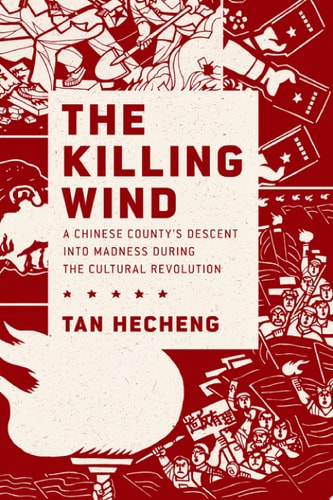
The Killing Wind: A Chinese County's Descent into Madness during the Cultural Revolution
0
0
As an Amazon Associate and affiliate partner, Menrva Books earns from qualifying purchases. Learn more
Author Description
Over the course of 66 days in 1967, more than 4,000 "class enemies"--including young children and the elderly--were murdered in Daoxian, a county in China's Hunan province. The killings spread to surrounding counties, resulting in a combined death toll of more than 9,000. Commonly known as the Daoxian massacre, the killings were one of many acts of so-called mass dictatorship and armed factional conflict that rocked China during the Cultural Revolution. However, in spite of the scope and brutality of the killings, there are few detailed accounts of mass killings in China's countryside during the Cultural Revolution's most tumultuous years. Years after the massacre, journalist Tan Hecheng was sent to Daoxian to report on an official investigation into the killings. Tan was prevented from publishing his findings in China, but in 2010, he published the Chinese edition of The Killing Wind in Hong Kong. Tan's first-hand investigation of the atrocities, accumulated over the course of more than 20 years, blends his research with the recollections of survivors to provide a vivid account exploring how and why the massacre took place and describing its aftermath. Dispelling the heroic aura of class struggle, Tan reveals that most of the Daoxian massacre's victims were hard-working, peaceful members of the rural middle class blacklisted as landlords or rich peasants. Tan also describes how political pressure and brainwashing turned ordinary people into heartless killing machines.More than a catalog of horrors, The Killing Wind is also a poignant meditation on memory, moral culpability, and the failure of the Chinese government to come to terms with the crimes of the Maoist era. By painting a detailed portrait of this massacre, Tan makes a broader argument about the long-term consequences of the Cultural Revolution, one of the most violent political movements of the twentieth century. A compelling testament to the victims and survivors of the Daoxian massacre, The Killing Wind
Menrva's Summary
THE THESIS
This work investigates the mechanisms of state-sanctioned violence and social collapse that enabled the mass killings in Daoxian during the Cultural Revolution. Journalist Tan Hecheng utilizes two decades of investigative research, including official government reports and personal interviews with survivors, to reconstruct the events of 1967. He argues that the massacre was not a spontaneous outburst of revolutionary fervor but a systematic result of political indoctrination and the deliberate targeting of rural populations labeled as class enemies.
THE SCOPE MAP
What You Will Find
- Detailed documentation of the 1967 Daoxian massacre in Hunan province.
- Analysis of the social and political pressures that facilitated mass violence among neighbors.
- First-hand accounts from survivors and witnesses of the atrocities.
Scope Limits
- The text focuses primarily on the Daoxian region and surrounding counties rather than a comprehensive national history of the Cultural Revolution.
- It does not provide an exhaustive legal analysis of the subsequent government investigations.
THE AUTHORITY PERSPECTIVE
Scholars and historians recognize this work as a critical primary-source-heavy account of rural violence during the Maoist era. Readers frequently note the sobering density of the prose and the author's commitment to preserving the memory of victims who were largely ignored by official state narratives.
Page Count:
533
Publication Date:
2016-01-01
Publisher:
Oxford University Press
ISBN-10:
0190622547
ISBN-13:
9780190622541
Non-Fiction
History
Massacres
Asian History
Human rights
Community Tags
Similar Books