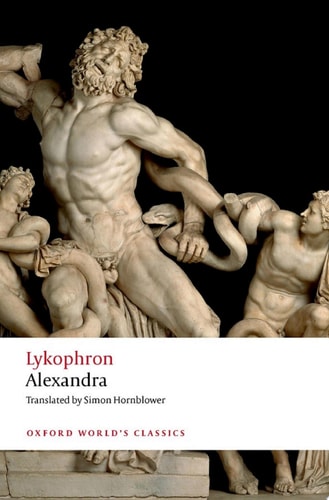
Lykophron: Alexandra
0
0
As an Amazon Associate and affiliate partner, Menrva Books earns from qualifying purchases. Learn more
Author Description
Traditionally ascribed to the early third-century BCE tragedian Lykophron, the Alexandra is a powerful Greek poem by an unknown author, probably written c. 190, when Rome had defeated Hannibal and the Carthaginians and was poised to humble the Seleukid king Antiochos III. The poem is an ingeniously constructed masterpiece, a generic mix with elements of tragedy, epic, and history.Priam's beautiful daughter, the prophetic Kassandra, foresees her rape in Athena's temple by the hateful Greek warrior Ajax after Troy's fall, and warns of disastrous returns (nostoi) for all the Greek 'heroes'. But Troy will rise again as Rome, founded by Trojan refugees. Alexandra (another name for Kassandra), narrates these Mediterranean foundation myths, adopting a bitterly disillusioned female perspective, but culminating in prophecies of Roman rule over land and sea.
Menrva's Summary
THE PULSE
The prophetic Kassandra delivers a sprawling, cryptic monologue foretelling the destruction of Troy and the subsequent fates of the Greek victors. Kassandra, also known as Alexandra, serves as the primary narrator, recounting the tragic aftermath of the Trojan War from a position of captivity. Her objective is to articulate the inevitable collapse of the Greek heroes and the eventual rise of Rome as the successor to Trojan glory. The narrative framework relies on a complex, dense monologue that weaves together mythological history and political prophecy, constrained by the speaker's bitter perspective and the rigid structure of the poem's obscure, allusive language.
INSIDE THE PAGES
- Dramatic monologue structure
- Prophetic narrative voice
- Integration of Greek foundation myths
- Allusive and dense linguistic style
- Blending of tragic, epic, and historical genres
- Focus on the nostoi (returns) of Greek heroes
- Reinterpretation of the fall of Troy
- Political commentary on Roman expansion
THE COLLECTIVE ECHO
Readers and scholars frequently note the extreme density and linguistic difficulty of the text, which is famous for its obscure vocabulary and complex mythological references. Discussion often centers on the poem's unique position as a bridge between Greek tragedy and the later Roman epic tradition. Critics highlight the author's ability to subvert traditional heroic narratives by adopting a disillusioned female perspective that challenges the standard accounts of the Trojan War. Many readers find the work challenging due to its reliance on deep knowledge of Hellenistic history and mythology, yet it remains a significant subject of study for those interested in the evolution of ancient literary forms.
Page Count:
192
Publication Date:
2022-01-01
Publisher:
OUP Oxford
ISBN-10:
0192608452
ISBN-13:
9780192608451
Poetry
English & College Success
English
Epic Poetry
Classical Greek Literature
Mythology
Ancient History
Community Tags
Similar Books