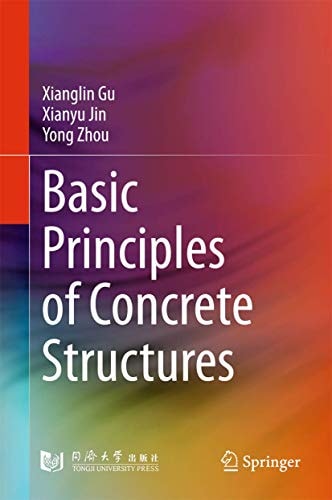
Basic Principles of Concrete Structures
0
0
As an Amazon Associate and affiliate partner, Menrva Books earns from qualifying purchases. Learn more
Author Description
Based on the latest version of designing codes both for buildings and bridges (GB50010-2010 and JTG D62-2004), this book starts from steel and concrete materials, whose properties are very important to the mechanical behavior of concrete structural members. Step by step, analysis of reinforced and prestressed concrete members under basic loading types (tension, compression, flexure, shearing and torsion) and environmental actions are introduced. The characteristic of the book that distinguishes it from other textbooks on concrete structures is that more emphasis has been laid on the basic theories of reinforced concrete and the application of the basic theories in design of new structures and analysis of existing structures. Examples and problems in each chapter are carefully designed to cover every important knowledge point. As a basic course for undergraduates majoring in civil engineering, this course is different from either the previously learnt mechanics courses or the design courses to be learnt. Compared with mechanics courses, the basic theories of reinforced concrete structures cannot be solely derived by theoretical analysis. And compared with design courses, this course emphasizes the introduction of basic theories rather than simply being a translation of design specifications. The book will focus on both the theoretical derivations and the engineering practices.
Menrva's Summary
THE THESIS
This book investigates the fundamental principles governing the design and analysis of concrete structures.
Authored by Xianglin Gu, Xianyu Jin, and Yong Zhou, this textbook delves into the properties of steel and concrete materials, crucial for understanding the mechanical behavior of structural members. It systematically introduces the analysis of reinforced and prestressed concrete elements under various loading conditions, including tension, compression, flexure, shearing, and torsion, as well as environmental actions. A key distinction of this work lies in its emphasis on the foundational theories of reinforced concrete and their practical application in designing new structures and assessing existing ones, bridging the gap between theoretical mechanics and design specifications.
THE SCOPE MAP
- Properties of steel and concrete materials
- Analysis of reinforced and prestressed concrete members under tension, compression, flexure, shearing, and torsion
- Introduction to environmental actions on concrete structures
- Application of basic theories in the design of new structures
- Analysis of existing concrete structures
- Examples and problems designed to cover key knowledge points
- Focus on both theoretical derivations and engineering practices
THE AUTHORITY PERSPECTIVE
This textbook is structured as a foundational course for undergraduate civil engineering students, differentiating itself from pure mechanics or design courses by emphasizing the theoretical underpinnings of reinforced concrete structures. It aims to provide a comprehensive understanding that bridges theoretical derivations with practical engineering applications. The inclusion of carefully designed examples and problems in each chapter suggests a pedagogical approach focused on reinforcing core concepts and their real-world relevance.
Page Count:
606
Publication Date:
2019-03-27
Publisher:
Springer Berlin Heidelberg
ISBN-10:
3662569388
ISBN-13:
9783662569382
Non-Fiction
Science & Technology
Structural Engineering
Engineering Textbooks
Civil Engineering
Community Tags
Other Editions(2)
Similar Books