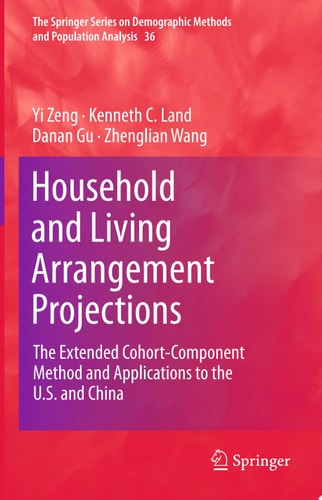
Household and Living Arrangement Projections
0
0
As an Amazon Associate and affiliate partner, Menrva Books earns from qualifying purchases. Learn more
Author Description
This book presents an innovative demographic toolkit known as the ProFamy extended cohort-component method for the projection of household structures and living arrangements with empirical applications to the United States, the largest developed country, and China, the largest developing country. The ProFamy method uses demographic rates as inputs to project detailed distributions of household types and sizes, living arrangements of all household members, and population by age, sex, race/ethnicity, and urban/rural residence at national, sub-national, or small area levels. It can also project elderly care needs and costs, pension deficits, and household consumption. The ProFamy method presented herein has substantial merits compared to the traditional headship rate method, which is not linked to demographic rates and projects limited household types without other household members than "heads". The book consists of four parts. The first part presents the methodology, data, estimation issues, and empirical assessments. The next parts present applications in the United States (part two) and China (part three), concerning demographic, social, economic, and business research; policy analysis, including forecasting future trends of household type/size, elderly living arrangements, disability, and home-based care costs, and household consumption including housing and vehicles. The fourth part includes a user’s guide for the ProFamy software to project households, living arrangements, and home-based consumptions. This book offers an invaluable toolkit for researchers, analysts and students in academic, public and private businesses, whose work is related to levels and rates of change in households, population and consumption patterns.
Menrva's Summary
THE THESIS
This book introduces the ProFamy extended cohort-component method, a novel demographic toolkit for projecting detailed household structures and living arrangements. The ProFamy method, unlike traditional headship rate methods, utilizes demographic rates as inputs to forecast granular distributions of household types and sizes, the living arrangements of all household members, and population breakdowns by age, sex, race/ethnicity, and urban/rural residence. It offers empirical applications for both the United States and China, addressing critical areas such as elderly care needs, pension deficits, and household consumption. The methodology is presented in four parts, covering the core techniques, estimation challenges, empirical assessments, and detailed applications for both countries, culminating in a user's guide for the accompanying software.
THE SCOPE MAP
- The ProFamy extended cohort-component method for household and living arrangement projections.
- Detailed distributions of household types and sizes.
- Living arrangements of all household members.
- Population projections by age, sex, race/ethnicity, and urban/rural residence.
- Projections of elderly care needs, costs, and pension deficits.
- Analysis of household consumption patterns, including housing and vehicles.
- Empirical applications and case studies for the United States and China.
- A user's guide for the ProFamy software.
THE AUTHORITY PERSPECTIVE
The book presents a sophisticated demographic toolkit, the ProFamy method, designed for detailed projections of household structures and living arrangements. Its strength lies in its empirical applications to both the United States and China, offering a comparative analysis of demographic trends and policy implications. The inclusion of a user's guide for the ProFamy software suggests a practical orientation, aiming to equip researchers and analysts with a functional tool. The methodology's advantages over traditional methods are highlighted, positioning it as an innovative contribution to demographic analysis and forecasting.
Page Count:
357
Publication Date:
2013-12-16
Publisher:
Springer Nature
ISBN-10:
9048189063
ISBN-13:
9789048189069
Non-Fiction
Science & Technology
Economics
Methodology
Social Science
Population Studies
Demographics
China Studies
Community Tags
Similar Books