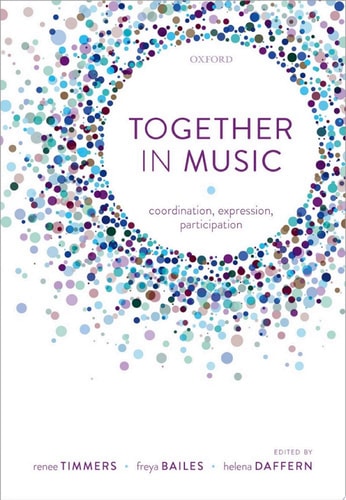
Together in Music: Coordination, Expression, Participation
0
0
As an Amazon Associate and affiliate partner, Menrva Books earns from qualifying purchases. Learn more
Author Description
Recent years have seen a rise in interest, from a diversity of fields, in the musical ensemble as an exemplary form of creative group behavior. Musical ensembles can be understood and investigated as high functioning small group organizations that have coordinative structures in place to perform under pressure within strict temporal boundaries. Rehearsals and performances exemplify fruitful contexts for emergent creative behaviour, where novel musical interpretations are negotiated and discovered through improvisatory interaction. Furthermore, group music-making can be an emotionally and socially rewarding experience that enables positive outcomes for wellbeing and development. This book brings together these different perspectives into one coherent volume, offering insight into the musical ensemble from different analytical levels. Part 1 starts from the meso-level, considering ensembles as creative teams and investigating how musical groups interact at a social and organizational level. Part 2 then zooms in to consider musical coordination and interaction at a micro-level, when considering group music-making as forms of joint action. Finally, a macro-level perspective is taken in Part 3, examining the health and wellbeing affordances associated with acoustical, expressive, and emotional joint behavior. Each part contains a balance of review chapters showcasing the most recent developments in each area of research, followed by demonstrative case studies featuring various ensemble practices and processes. A rich and multidisciplinary reflection on ensemble music practice, this volume will be an insightful read for music students, teachers, academics, and professionals with an interest in the dynamics of group behavior within a musical context.
Menrva's Summary
THE THESIS
This volume investigates the musical ensemble as a high-functioning small group organization, exploring how coordinative structures, creative interaction, and social dynamics facilitate performance under pressure. The author synthesizes perspectives from psychology, sociology, and musicology to analyze how ensembles function as creative teams. By examining group behavior across three distinct analytical levels, the text provides a framework for understanding the cognitive, social, and emotional mechanisms inherent in joint musical action.
THE SCOPE MAP
What You Will Find
- Meso-level analysis of ensembles as creative teams and organizational structures
- Micro-level examination of musical coordination as joint action
- Macro-level investigation into health and wellbeing outcomes of group music-making
- Review chapters detailing recent research developments
- Case studies illustrating various ensemble practices and processes
Scope Limits
- Does not provide instruction on specific musical techniques or instrument proficiency
- Does not cover the history of music theory or composition styles
THE AUTHORITY PERSPECTIVE
Experts identify this work as a comprehensive, multidisciplinary resource for academics and practitioners interested in the intersection of music and group dynamics. Readers frequently note the academic density of the prose, which effectively bridges the gap between theoretical research and practical ensemble application.
Page Count:
312
Publication Date:
2021-01-01
Publisher:
OUP Oxford
ISBN-10:
0192605178
ISBN-13:
9780192605177
Psychology
Music
Music Education
Sociology
Performance Studies
Group Dynamics
Community Tags
Similar Books