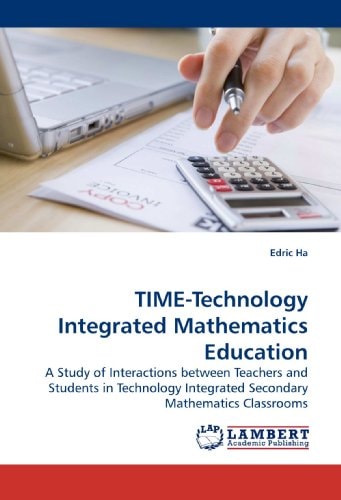
TIME-Technology Integrated Mathematics Education: A Study of Interactions Between Teachers and Students in Technology Integrated Secondary Mathematics Classrooms
0
0
As an Amazon Associate and affiliate partner, Menrva Books earns from qualifying purchases. Learn more
Author Description
The results of numerous national and international assessments have raised concerns regarding secondary mathematics education in the United States. According to government reports, there has been a significant increase in the use of technology in U.S. schools in the last decade. However, student achievement in mathematics has not improved during this time. A qualitative case study involved observing and interviewing two high school mathematics teachers and 48 high school students in three Advanced Placement (AP) mathematics classes. The study focused on what students and teachers thought about the integration of technology in mathematics education, on how they actually used technology in class, on whether technology helped students to learn cooperatively, and on whether technology helped teachers improve their instruction. Collective results from questionnaire data, interview data, and class observations helped to build an understanding about how technology was used in the three secondary mathematics classrooms.
Menrva's Summary
THE THESIS
This study investigates the complex interplay between technology integration and student-teacher interactions within secondary mathematics classrooms, particularly in the context of Advanced Placement courses. The research addresses concerns about stagnant student achievement in U.S. mathematics despite increased technology use, employing a qualitative case study approach. It involved direct observation and interviews with two high school mathematics teachers and 48 students across three AP classes to understand their perceptions and actual use of technology. The study aimed to determine technology's impact on cooperative learning and instructional improvement.
THE SCOPE MAP
- Analysis of student and teacher perceptions regarding technology integration in mathematics.
- Detailed observations of how technology was practically applied in three AP mathematics classrooms.
- Examination of technology's role in fostering cooperative learning among students.
- Assessment of technology's effectiveness in enhancing teacher instruction.
- Synthesis of data from questionnaires, interviews, and classroom observations.
- Insights into the challenges and benefits of technology integration in secondary math education.
THE AUTHORITY PERSPECTIVE
The study offers a detailed qualitative examination of technology integration in secondary mathematics, a topic of significant concern given persistent achievement gaps. By focusing on teacher-student interactions and the practical application of tools, it provides nuanced insights beyond broad policy discussions. The methodology, combining observation, interviews, and questionnaires, allows for a comprehensive understanding of the classroom environment. This work is likely to be of interest to educators, researchers, and policymakers seeking to understand the real-world impact of technology in mathematics education.
Page Count:
248
Publication Date:
2009-09-01
Publisher:
Lap Lambert Academic Publishing GmbH KG
ISBN-10:
383831316X
ISBN-13:
9783838313160
Non-Fiction
Science & Technology
Mathematics Education
Education
Secondary Education
Qualitative Research
Community Tags
Similar Books