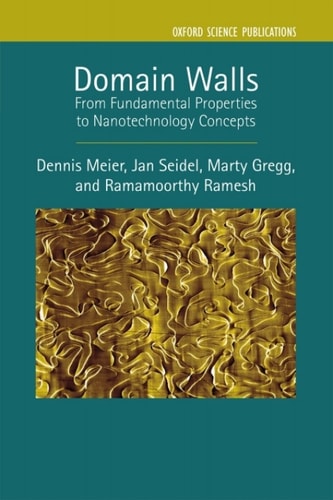
Domain Walls: From Fundamental Properties to Nanotechnology Concepts
0
0
As an Amazon Associate and affiliate partner, Menrva Books earns from qualifying purchases. Learn more
Author Description
Technological evolution and revolution are both driven by the discovery of new functionalities, new materials and the design of yet smaller, faster, and more energy-efficient components. Progress is being made at a breathtaking pace, stimulated by the rapidly growing demand for more powerful and readily available information technology. High-speed internet and data-streaming, home automation, tablets and smartphones are now "necessities" for our everyday lives. Consumer expectations for progressively more data storage and exchange appear to be insatiable. Oxide electronics is a promising and relatively new field that has the potential to trigger major advances in information technology. Oxide interfaces are particularly intriguing. Here, low local symmetry combined with an increased susceptibility to external fields leads to unusual physical properties distinct from those of the homogeneous bulk. In this context, ferroic domain walls have attracted recent attention as a completely new type of oxide interface. In addition to their functional properties, such walls are spatially mobile and can be created, moved, and erased on demand. This unique degree of flexibility enables domain walls to take an active role in future devices and hold a great potential as multifunctional 2D systems for nanoelectronics. With domain walls as reconfigurable electronic 2D components, a new generation of adaptive nano-technology and flexible circuitry becomes possible, that can be altered and upgraded throughout the lifetime of the device. Thus, what started out as fundamental research, at the limit of accessibility, is finally maturing into a promising concept for next-generation technology.
Menrva's Summary
THE THESIS
This text investigates the potential of ferroic domain walls in oxide materials to serve as reconfigurable, functional components for next-generation nanoelectronics.
The authors, a team of experts in semiconductor science and materials physics, synthesize current research on oxide interfaces. They argue that the unique physical properties of domain walls—specifically their mobility and susceptibility to external fields—provide a viable pathway for developing adaptive, energy-efficient circuitry. The book bridges the gap between fundamental condensed matter physics and practical application in information technology.
THE SCOPE MAP
What You Will Find
- Theoretical framework of ferroic domain walls in oxide materials
- Analysis of symmetry breaking at oxide interfaces
- Discussion on the creation, manipulation, and erasure of domain walls
- Applications in nanoelectronics and adaptive circuitry
Scope Limits
- Does not provide a comprehensive history of all semiconductor materials
- Focuses primarily on oxide-based systems rather than traditional silicon-based electronics
THE AUTHORITY PERSPECTIVE
Experts recognize this work as a technical resource for researchers and graduate students in the field of condensed matter physics. Readers frequently note the high level of academic density and the specialized nature of the material presented.
Page Count:
368
Publication Date:
2020-01-01
Publisher:
OUP Oxford
ISBN-10:
0192607413
ISBN-13:
9780192607416
Science
Solid-State Physics
Technology
Earth Sciences
Semiconductor Physics
Nanotechnology
Community Tags
Other Editions(2)
Similar Books










Reader Comments
Share Your Thoughts
No comments yet. Be the first to share your thoughts!