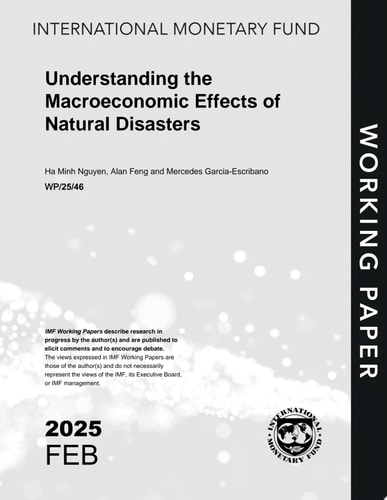
Understanding the Macroeconomic Effects of Natural Disasters
0
0
As an Amazon Associate and affiliate partner, Menrva Books earns from qualifying purchases. Learn more
Author Description
Climate change is causing more frequent and devastating natural disasters. The goal of this paper is two-fold. First, it examines the dynamic effects of natural disasters on the growth of output and its components. Government expenditure in advanced economies (AEs) rises immediately in the same year of the natural disaster, offsetting the decline in private investment growth and thereby mitigating the negative effect on output growth. As a result, output growth in AEs is not significantly affected by natural disasters. In contrast, the increase in government expenditure in emerging markets and developing countries (EMDEs) after a natural disaster is smaller and thus, unable to mitigate the contemporaneous negative effect on output growth (which mainly reflects the fall in investment in non-small-island EMDEs and in net exports in small-island EMDEs). In addition, the output recovery in the subsequent year does not fully offset the decline during the year of the disaster. Second, this paper assesses the role of pre-existing country characteristics in mitigating the adverse impact of natural disasters. The paper finds that small islands and countries with limited pre-disaster fiscal space tend to experience more significant declines in output growth following a natural disaster.
Menrva's Summary
THE THESIS
This paper investigates the macroeconomic consequences of natural disasters, particularly their impact on economic growth and the factors that mitigate these effects. The authors examine the dynamic effects of natural disasters on output and its components, differentiating between advanced economies (AEs) and emerging markets and developing countries (EMDEs). In AEs, government expenditure increases mitigate the negative impact on output growth, while in EMDEs, smaller increases in government spending are insufficient to offset the decline, particularly in investment and net exports. The study also assesses how pre-existing country characteristics, such as fiscal space and island status, influence the severity of these adverse impacts.
THE SCOPE MAP
- Analysis of the dynamic effects of natural disasters on output growth and its components.
- Comparative study of macroeconomic responses in Advanced Economies (AEs) versus Emerging Markets and Developing Countries (EMDEs).
- Examination of the role of government expenditure in mitigating disaster impacts.
- Assessment of how pre-existing country characteristics (fiscal space, island status) affect vulnerability.
- Data on output recovery patterns in the year following a natural disaster.
THE AUTHORITY PERSPECTIVE
This paper offers a detailed analysis of the macroeconomic repercussions of natural disasters, distinguishing between different country types and identifying key mitigating factors. The research highlights the critical role of government fiscal response in advanced economies compared to developing nations. It also points to specific vulnerabilities in small island nations and countries with limited fiscal space. The findings provide valuable insights for policymakers seeking to build resilience against climate-related economic shocks.
Page Count:
26
Publication Date:
2025-02-21
Publisher:
International Monetary Fund
ISBN-13:
9798229001939
Non-Fiction
Economics
Public Policy
Community Tags
Similar Books