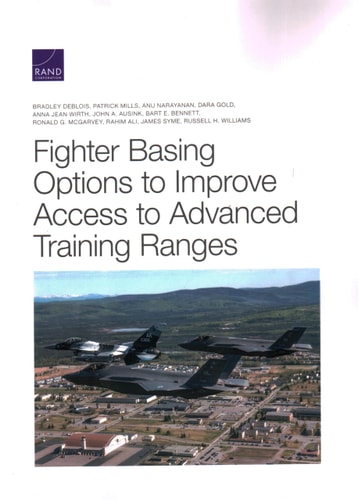
Fighter Basing Options to Improve Access to Advanced Training Ranges
0
0
As an Amazon Associate and affiliate partner, Menrva Books earns from qualifying purchases. Learn more
Author Description
The U.S. Air Force (USAF) has determined that its fighter pilots do not currently have sufficient access to training ranges with airspace, threat emitters, targets, and electronic support measures capable of representing advanced potential adversaries. The USAF is developing a plan to upgrade certain ranges with these capabilities. In addition, the USAF may consider potential fighter squadron restationing options that would improve access to the upgraded training ranges. The authors developed an optimization model to determine the combinations of range upgrades and squadron restationing options that provide the highest levels of effectiveness given different policy constraints. They developed one-time move costs associated with squadron restationing and compared those with preliminary range upgrade cost estimates. Finally, the authors collected data on the risks from natural hazards and power outages for the set of bases and ranges under consideration. The authors found that range upgrades alone might not ensure sufficient access to advanced ranges and that restationing fighter squadrons can provide additional access, but the amount depends on institutional freedom to make restationing decisions. The one-time costs for restationing a fighter squadron and range modernization are on the same order of magnitude, but range upgrades may be substantially more expensive over the long term. The authors recommend that the USAF assess the effectiveness, costs, and risks of restationing presented in this report against other potential solutions for providing access to advanced ranges.
Menrva's Summary
THE THESIS
The U.S. Air Force faces a critical deficit in advanced training range access for its fighter pilots, necessitating a strategic evaluation of range upgrades and potential squadron restationing. The authors address this challenge by developing an optimization model to identify the most effective combinations of range modernization and base relocation strategies, considering various policy constraints. They analyze one-time move costs for squadrons against preliminary range upgrade estimates and incorporate data on natural hazard and power outage risks for relevant bases and ranges. Their findings indicate that range upgrades alone may be insufficient, and while restationing offers additional access, its impact is contingent on institutional flexibility, with both restationing and modernization costs being of a similar order of magnitude, though range upgrades may incur higher long-term expenses.
THE SCOPE MAP
- An optimization model for determining effective combinations of range upgrades and squadron restationing.
- Analysis of one-time move costs associated with squadron restationing.
- Preliminary cost estimates for range upgrades.
- Data on risks from natural hazards and power outages for bases and ranges.
- Comparison of the effectiveness and costs of range upgrades versus squadron restationing.
- Assessment of the impact of institutional freedom on restationing decisions.
THE AUTHORITY PERSPECTIVE
This report presents a data-driven analysis for the U.S. Air Force concerning the strategic improvement of fighter pilot training range access. The authors' methodology, which includes an optimization model and cost-benefit analysis incorporating risk factors, suggests a comprehensive approach to decision-making. The findings highlight the potential limitations of relying solely on range upgrades and emphasize the nuanced benefits of squadron restationing, while also noting the significant long-term cost implications of modernization. The report concludes with a recommendation for the USAF to weigh these findings against other solutions for enhanced training capabilities.
Page Count:
78
Publication Date:
2021-01-01
Publisher:
RAND Corporation
ISBN-10:
1977406432
ISBN-13:
9781977406439
Non-Fiction
Science & Technology
Defense Policy
Logistics
Military
Operations Research
Community Tags
Similar Books