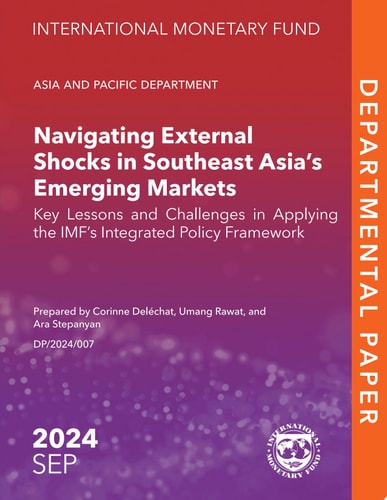
Navigating External Shocks in Southeast Asia's Emerging Markets: Key Lessons and Challenges in Applying the IMF’s Integrated Policy Framework
0
0
As an Amazon Associate and affiliate partner, Menrva Books earns from qualifying purchases. Learn more
Author Description
As relatively small open economies, South-East Asian emerging markets (Indonesia, Malaysia, Philippines and Thailand or ASEAN-4) are highly susceptible to external shocks—both financial and real—that could induce large capital flows and exchange rate volatility that could lead to foreign exchange market dysfunction. With the exception of Bank Negara Malaysia, ASEAN-4 central banks mostly have flexible inflation-targeting frameworks for monetary policy implementation. Their main policy objectives include medium-term price stability, sustainable economic growth, and financial stability. Central Banks in ASEAN-4 economies have been early pilots in the operationalization of the IMF’s Integrated Policy Framework (IPF) in 2022-23, given their experience in using multiple policy tools besides the monetary policy rate, including macroprudential measures, foreign exchange intervention (FXI), and capital flow management measures, to achieve their multiple objectives. They have welcomed the IPF as a systematic, frictions-based approach to analyze the use of these multiple tools to manage trade-offs across policy objectives. This paper takes stock of the experience from these pilots, both from the perspective of country authorities and of IMF country teams. It aims at distilling key lessons, which could be used to inform broader IPF operationalization. The IPF conceptual framework and a related quantitative model were used to assess policy trade-offs in ASEAN-4 in the event of adverse external shocks. These applications reaffirmed the importance of using monetary policy to address persistent inflationary pressures stemming from real shocks and allowing the exchange rate to act as a shock absorber. However, a complementary use of FXI could improve trade-offs between price, financial, and output stability when economies are faced with large and financial shocks that result in abrupt spikes in uncovered interest rate parity premia resulting in inefficiently tight financial conditi
Menrva's Summary
THE THESIS
This paper investigates the susceptibility of Southeast Asian emerging markets to external economic shocks and evaluates the application of the IMF’s Integrated Policy Framework (IPF) in managing these challenges. The ASEAN-4 economies (Indonesia, Malaysia, Philippines, and Thailand) are particularly vulnerable due to their status as small, open economies, facing risks of significant capital flows and exchange rate volatility. Central banks in these nations, largely employing flexible inflation-targeting frameworks, aim for price stability, economic growth, and financial stability. This work analyzes the experiences of these central banks as early adopters of the IPF, examining their use of diverse policy tools beyond interest rates, such as macroprudential measures and foreign exchange interventions, to navigate complex policy trade-offs.
THE SCOPE MAP
- Analysis of external shocks (financial and real) impacting Southeast Asian emerging markets.
- Evaluation of the IMF’s Integrated Policy Framework (IPF) and its operationalization.
- Case studies from ASEAN-4 central banks (Indonesia, Malaysia, Philippines, Thailand).
- Examination of monetary policy, macroprudential measures, foreign exchange intervention (FXI), and capital flow management measures.
- Assessment of policy trade-offs between price stability, economic growth, and financial stability.
- Application of the IPF conceptual framework and a related quantitative model.
- Distillation of key lessons for broader IPF operationalization.
THE AUTHORITY PERSPECTIVE
This paper offers a timely analysis of critical economic challenges faced by Southeast Asian emerging markets, drawing on the practical experiences of central banks in the ASEAN-4 region. By examining the application of the IMF's Integrated Policy Framework, the authors provide valuable insights into the effective management of external shocks and policy trade-offs. The work is grounded in the operational realities of these economies, aiming to extract actionable lessons for broader policy implementation. The research is expected to be of significant interest to policymakers, economists, and international financial institutions concerned with emerging market stability.
Page Count:
42
Publication Date:
2024-09-23
Publisher:
International Monetary Fund
ISBN-13:
9798400285790
Economics
Non-Fiction
International relations
Finance
Community Tags
Similar Books












Reader Comments
Share Your Thoughts
No comments yet. Be the first to share your thoughts!