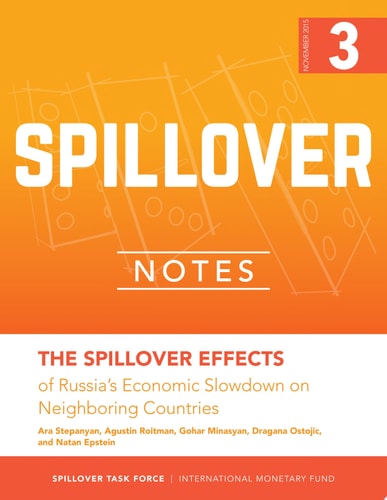
The Spillover Effects of Russia’s Economic Slowdown on Neighboring Countries
0
0
As an Amazon Associate and affiliate partner, Menrva Books earns from qualifying purchases. Learn more
Author Description
In the face of sharply lower oil prices and geopolitical tensions and sanctions, economic activity in Russia decelerated in late 2014, resulting in negative spillovers on Commonwealth of Independent States (CIS) and, to a lesser extent, on Baltic countries. The spillovers to eastern Europe have been limited. The degree of impact is commensurate with the level of these countries’ trade, remittances, and foreign direct investment (FDI) links with Russia. So far, policy action by the affected countries has focused on mitigating the immediate consequences of spillovers.
Menrva's Summary
THE THESIS
This book investigates the economic repercussions of Russia's 2014 slowdown on its neighboring countries. The analysis, authored by Agustin Roitman, Ara Stepanyan, Gohar Minasyan, Natan P. Epstein, and Dragana Ostojic, examines how decreased oil prices, geopolitical tensions, and sanctions impacted the Commonwealth of Independent States (CIS) and Baltic nations. It quantifies the spillovers based on trade, remittances, and foreign direct investment (FDI) links, while also noting the limited impact on Eastern Europe. The work details the policy responses undertaken by affected countries to manage these immediate economic consequences.
THE SCOPE MAP
- Analysis of economic spillovers from Russia's slowdown to CIS and Baltic countries.
- Quantification of impact based on trade, remittances, and FDI links.
- Assessment of the limited spillovers to Eastern Europe.
- Examination of policy actions taken by affected countries to mitigate consequences.
THE AUTHORITY PERSPECTIVE
This report provides a focused analysis of the economic interdependencies between Russia and its neighboring countries following the 2014 economic slowdown. It details the mechanisms through which economic shocks propagate, particularly concerning trade and investment flows. The work serves as a valuable resource for understanding the regional economic dynamics and the policy challenges faced by countries reliant on Russia.
Page Count:
26
Publication Date:
2016-09-27
Publisher:
International Monetary Fund
ISBN-10:
1475541430
ISBN-13:
9781475541434
Economics
Non-Fiction
International relations
Geopolitics
Community Tags
Similar Books